Affiliate marketing pays partners for a result, usually a sale or a signup. Influencer marketing usually pays upfront for content and access to an audience, though commission and hybrid deals have become common too.
That one difference in what you are buying shapes everything downstream: who controls the creative, how sales get tracked, and how much money you risk before the first order lands.
This guide works through the affiliate marketing vs influencer marketing decision across six comparisons, the honest pros and cons of each, the disclosure rules both channels have to follow, and the hybrid setup that combines them.
Key Takeaways
- Affiliate marketing pays on results. Influencer marketing usually pays upfront for content and reach, so the risk sits in a different place.
- Affiliates capture demand that already exists. Influencers create demand among people who were not searching yet.
- Affiliate sales are tracked with referral links and cookies. Influencer sales usually need personal discount codes, because Instagram Stories and TikTok limit clickable links.
- In the US, both channels fall under the FTC's Endorsement Guides, and the advertiser stays responsible for what its partners post.
- Hybrid deals, a smaller flat fee plus tiered commission, are the practical middle ground for brands that want content and measurable sales.
What Is Affiliate Marketing, and What Is Influencer Marketing?
Affiliate marketing is performance-based. External partners promote your product, and when they generate a result such as a sale, a lead, or a signup, they earn a commission. Influencer marketing means paying creators who already hold a trusted audience to build awareness, engagement, and, over time, conversions.
Both channels put a third party between a brand and its customers. What separates them is what that third party gets paid for.
How Does Affiliate Marketing Work?
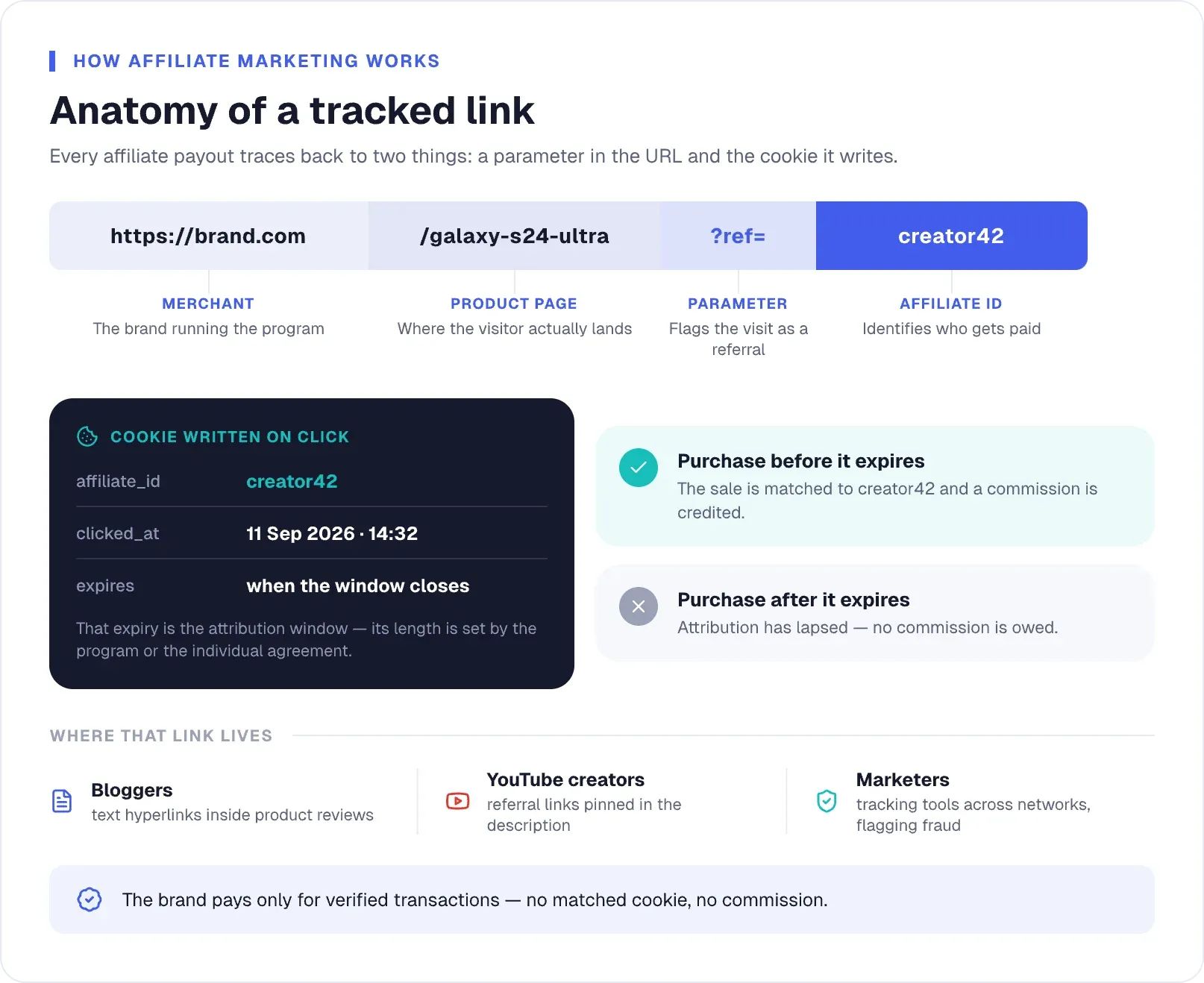
Brands give affiliates unique referral links carrying tracking cookies. How long a cookie stays valid, known as the attribution window, depends on the program or the individual agreement. If someone buys inside that window, the affiliate earns a commission and the brand pays only for verified transactions.
Tracking looks different by channel. Bloggers use text hyperlinks inside product reviews, while YouTube creators put links in video descriptions. Marketers use dedicated affiliate performance tracking tools to monitor results across networks and catch commission fraud.
How Does Influencer Marketing Work?
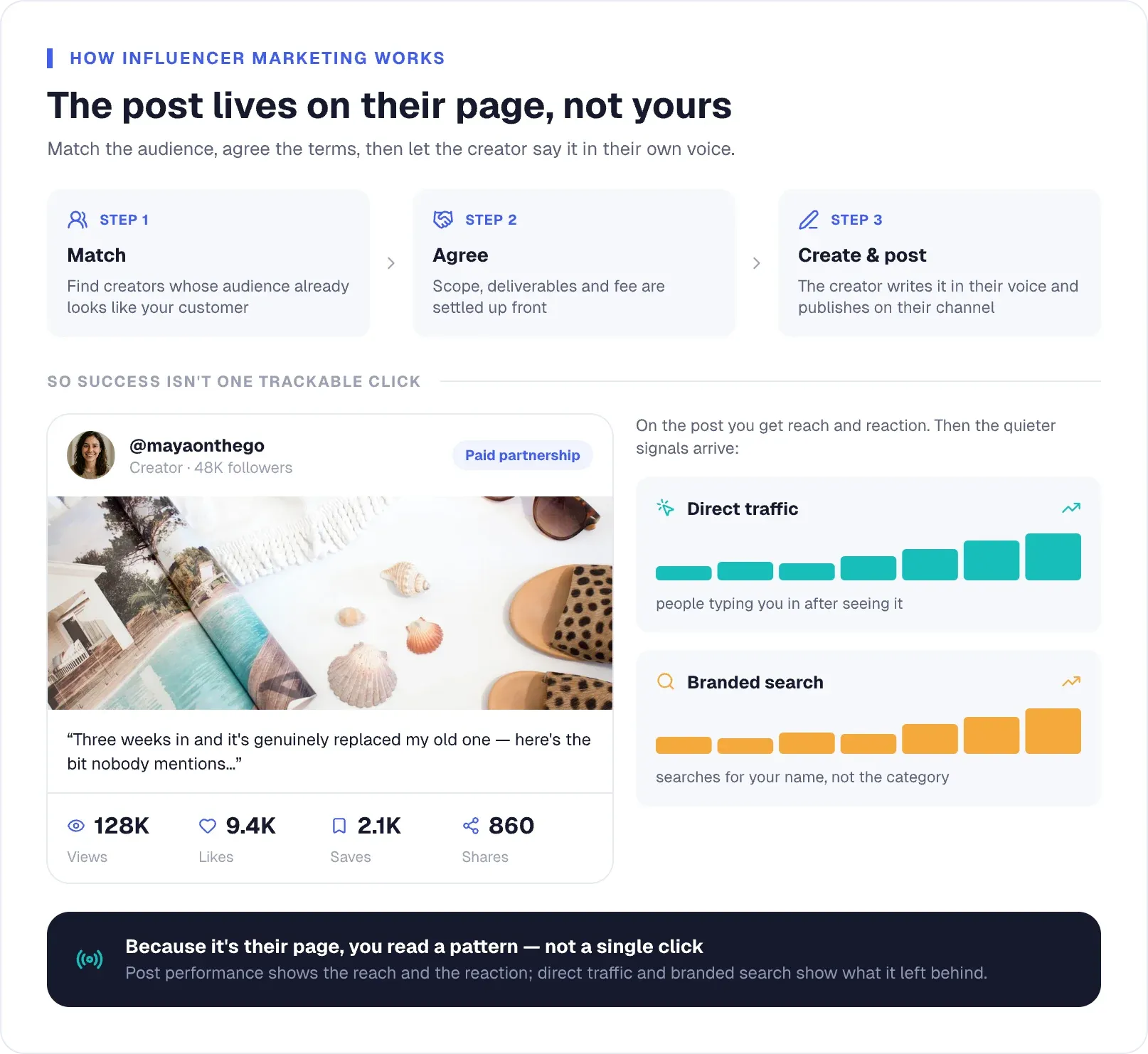
Influencer marketing starts by matching a brand to creators whose audiences already resemble its target customers. Once both sides agree on scope, deliverables, and fee, the creator produces content in their own voice and posts it on their own channel, so the promotion reads as native rather than as an ad.
Because the content lives on the creator's page and not the brand's, success is not only a trackable click. It shows up in how the post performs (views, engagement, saves, shares) plus any later lift in direct traffic or branded search.
Where Does Each Channel Actually Run?
Affiliate links are not tied to one place. The same link can sit on a personal blog, a review site, a coupon site, a newsletter, or inside content ranking in the SERP (search engine results page), on top of social posts.
Influencer marketing is most associated with Instagram, TikTok, and YouTube, though creators also reach audiences through podcasts, newsletters, and private communities. The practical consequence is dependency: an affiliate program can shift traffic between publishers, while a creator's reach is tied to one platform's algorithm.
Affiliate Marketing vs Influencer Marketing: 6 Key Differences Explained
Both models use third-party voices, and they diverge on payment, distribution, objective, creative control, attribution, and risk. The table below is the short version. The sections after it explain what each row means when you actually run a campaign.
| Feature | Affiliate Marketing | Influencer Marketing |
|---|---|---|
| Payment structure | Performance-based: CPA (cost per acquisition) or RevShare (a share of revenue) | Flat fees, product gifting, commission, or a hybrid of these |
| Primary goal | Bottom-of-funnel direct conversions | Top-of-funnel brand awareness and trust |
| Platforms and channels | Social media, personal websites, SERP content, review sites, coupon sites and more | Mainly social media platforms |
| Content control | High affiliate autonomy over promotion | Brand-approved creative guidelines |
| Tracking and attribution | Precise link and coupon tracking | Estimated reach, views, and engagement |
| Risk level | Low financial risk (pay on result) | Moderate risk with no guaranteed sales |
1. Payment Structure: What Are You Actually Paying For?
Most affiliates earn a commission only when they produce a result, such as a sale or a signup. Influencers more often receive an upfront fee for creating content, though plenty of deals now add commission, product gifting, or performance bonuses on top.
That changes the cash flow. Affiliate programs need little money up front because payment follows revenue. Influencer campaigns can require real budget before anything ships, especially with fixed fees, which is part of why hybrid structures caught on.
Production effort shows up in the price too. A long-form YouTube review costs more than a single story post because it takes more work to make. Affiliate content has a different tail: if a review keeps ranking in search, it can keep earning commissions months after publication.
2. Platforms and Channels: Who Owns the Distribution?
Influencers work almost entirely inside social platforms, and that is the point. Their value is the audience they built somewhere specific, which also ties their reach to that platform's algorithm and policy changes.
Affiliates spread the same offer wherever it converts: a personal site, search-ranking content, review and coupon sites, email lists, and social posts as well. When one traffic source dries up, a publisher network can shift. A single creator's audience cannot move with them nearly as easily.
3. Campaign Goals: Capturing Demand or Creating It?
Affiliate campaigns chase conversions that are already close to happening. Influencer campaigns build awareness, familiarity, and trust first.
A TikTok creator can trigger an impulse purchase with a 20-second video. An affiliate blogger picks up the same buyer later, at the moment they type a comparison query into Google. Run both, and the sequence works in your favor: social content creates the interest, and search content collects it.
4. Content Control: How Much Say Does the Brand Get?
Brands usually give affiliates wide freedom in how they promote a link, limited mainly by basic brand safety rules. Influencer deals run through creative briefs and approval rounds instead, so the final post matches tone, messaging, and compliance requirements.
An Instagram deal often specifies visuals, hashtags, and brand tags. Affiliate networks tend to hand over pre-approved banners and text links, then let the publisher decide placement. Less oversight, and far less admin work as well.
5. Tracking and Attribution: Can You Prove the Sale?
Affiliate tracking is precise. Cookies and custom URLs map each order back to a specific link. Influencer results usually come through softer signals such as engagement rate, views, and branded search lift, because a single post rarely creates a clean path to checkout.
Attribution gets messy when someone watches an Instagram Story on a phone at night and buys on a desktop three days later. The standard fix is a personal discount code for each creator, which ties early exposure to an actual order without depending on a click.
6. Financial Risk: What Happens if the Campaign Flops?
Affiliate marketing carries low financial risk, since commissions are owed only after a sale closes. Influencer marketing carries more, because the fee is due whether or not anything sells. What that fee buys is brand equity and creative assets that affiliate links do not produce.
A TikTok post might sell nothing in week one and still pay for itself if the video gets repurposed as a paid social ad that lowers acquisition costs elsewhere. Affiliate content rarely leaves that kind of reusable asset behind. It is efficient while it runs, but it builds little you can own.
H2: The Pros and Cons of Affiliate vs Influencer Marketing
Affiliates optimize for measurable performance. Influencers bring reach, trust, and creative assets, with sales potential attached rather than guaranteed. Every strength on one side has a matching cost on the other.
| Affiliate Marketing | Influencer Marketing | |
|---|---|---|
| Pros |
|
|
| Cons |
|
|
| Best fit |
|
|
When to Use Influencer vs Affiliate Marketing: A Decision-Making Guide
The choice comes down to three questions: how much budget you can commit before the first sale, whether people already search for what you sell, and whether the product needs to be seen to be understood.
Scenario 1: When to Choose Affiliate Marketing
Pick affiliate marketing if the budget is tight, the website already converts, and the goal is bottom-of-funnel sales. It works best for established products with existing search volume, where affiliates can intercept buyers who are already comparing options. If nobody searches for your category yet, affiliates have nothing to capture.
Scenario 2: When to Choose Influencer Marketing
Pick influencer marketing when you are launching something new, need content assets, or want to build long-term brand equity. It is the stronger option when a product needs visual demonstration, education, or storytelling to make sense. An unfamiliar gadget usually sells better after someone shows it working than after a coupon site lists it.
The 60-Second Decision Checklist
Answer these six before committing budget. More checks in the left column means start with affiliates. More in the right column means start with creators.
| Question | Yes points to affiliate | Yes points to influencer |
|---|---|---|
| Do people already search for this product category? | ✓ | |
| Does your site convert the traffic it already gets? | ✓ | |
| Is the priority revenue this quarter rather than brand building? | ✓ | |
| Can you pay before you see results? | ✓ | |
| Does the product need a demo to make sense? | ✓ | |
| Do you need content you can reuse in paid ads? | ✓ |
Industry Examples
Three brands show what each model looks like when it works.
Wirecutter is a strong example of an affiliate-led model. Its detailed product reviews target readers who are already researching purchases, and affiliate links connect that high-intent traffic to retailers. The model fits a publisher whose core asset is trusted, search-driven research.
Gymshark represents a creator- and athlete-led approach. Its early growth came from sending products to fitness creators who shared them with their communities, and those partnerships later expanded across social platforms. Fitness products reward demonstration, community participation, and creator credibility.
Daniel Wellington illustrates a hybrid, performance-oriented approach. The watch brand partnered with micro-influencers, providing free watches and unique promotional codes for their audiences. That combined creator buzz with a way to measure actual sales, which suits young brands that want broad social reach without betting everything on traditional ads.
For more influencer marketing examples, see Scrumball's 20 Best Influencer Marketing Campaigns to Learn From.
Disclosure Rules Both Channels Have to Follow
In the US, affiliate and influencer promotions both fall under the Federal Trade Commission's Endorsement Guides, and the obligation does not stop with the creator.
The FTC's Disclosures 101 for Social Media Influencers says a disclosure belongs with the endorsement message itself. Disclosures get missed when they appear only on a profile page, at the end of a post, or anywhere a reader has to click MORE, and they should not be buried inside a block of hashtags.
Format changes the placement. In a video, the disclosure has to sit in the video rather than only in the uploaded description. On Instagram Stories and Snapchat, superimpose it over the image and leave viewers enough time to read it.
Wording matters less than placement, but it still matters. The FTC treats "advertisement," "ad," and "sponsored" as clear, and warns against vague shorthand such as "sp," "spon," or "collab." Tagging a brand is an endorsement, not a disclosure.
Affiliate links count as a material connection even when no fee changed hands. In its Endorsement Guides FAQ, the FTC advises a review channel to disclose the affiliate relationship both inside the video and in the description near the links.
The same FAQ is blunt about who carries the risk: your company is ultimately responsible for what others do on your behalf, and handing a program to an agency does not relieve you of it. For short-lived formats like Stories, the FTC's suggested control is approving paid posts before they go up.
The Hybrid Strategy: How to Combine Influencer and Affiliate Marketing for Maximum ROI
Plenty of brands stop choosing and blend both into one system, often called performance-based influencer marketing. Creators get paid to create, then paid again when the content sells something. For a deeper look at how this works, see our guide to combining influencer and affiliate marketing.
How Does the Hybrid Payment Model Work?
The usual structure pairs a smaller flat fee for content production with tiered commissions on the sales that content generates. The fee covers the creator's production time, and the commission keeps them pushing their audience toward checkout, since more sales mean more income for them too.
Before locking in those numbers, brands still need a clear picture of budget, expected reach, and target ROI. That is what Scrumball's Lillian agent is built for: it scans your site and products, builds a campaign brief with budget and timeline, and estimates ROI before you approach creators.
You then walk into the fee-plus-commission negotiation with numbers instead of guesses.
How Do You Track a Hybrid Campaign?
Tracking method follows the platform. Where links are clickable, on blogs, in YouTube descriptions, and in Instagram bio links, trackable referral links and cookies attribute sales to individual creators. Where they are limited, as in some Stories and TikTok content, a personal discount code does the same job.
Reconciling both in one view is what makes tiered commissions payable. A hybrid campaign usually runs across several channels at once, mixing referral links and codes, and split reporting means sales go uncredited or get counted twice.
The money is moving this way. In March 2025, Emarketer forecast that US influencer marketing spending would pass $10 billion in 2025, one year earlier than the firm had previously predicted.
Running the Hybrid Model at Scale
Managing this by hand holds up for a handful of creators. Past that, matching creators, negotiating fee-plus-commission terms, and chasing discount codes across platforms turns into full-time administration.
AI platforms like Scrumball are built to close that gap, with AI agents covering strategy, discovery, outreach, campaign management, and performance tracking. The company reports a database of 180M+ verified influencer profiles across 190+ countries.
Scrumball's website also cites eco-friendly footwear brand VIVAIA, which used the platform to share its sustainability story with like-minded communities and reported a 27% reduction in marketing costs alongside a 148% increase in engagement.
If you are weighing an in-house build against a platform, Scrumball's comparison of 15 influencer outreach tools is a reasonable starting point, and current plans sit on the Scrumball pricing page.
Affiliate Marketing vs Influencer Marketing: Final Takeaway
Neither channel replaces the other. Affiliates convert existing demand cheaply and efficiently. Influencers create new demand and lasting brand trust. The brands that grow fastest usually run both: affiliates for steady, low-risk revenue, and creators for reach and reusable content.
If you are starting out, match the channel to your immediate goal rather than to whatever is trending. Once a campaign is live, tools like Scrumball's performance tracking make it easier to see which channel, or which combination, is actually paying off.
FAQ
Can an influencer also be an affiliate?
Yes. Many creators now work as social affiliates, using an audience they already built to drive traffic through personal affiliate links and discount codes instead of taking a flat fee. It lets them earn ongoing commission from content they would be posting anyway, and it lets brands tie creator reach to trackable sales.
Which is cheaper: influencer marketing vs affiliate marketing?
Affiliate marketing is cheaper to start, because nothing is owed until a sale happens. Influencer marketing usually requires upfront payment for content regardless of how many sales follow, which is why tight budgets tend to start with affiliates and add creator partnerships once there is proof the product converts.
How do brands track sales for influencer vs affiliate campaigns?
Affiliate sales are tracked through unique referral links and cookies. Influencer sales are usually tracked through personal discount codes, since platforms like Instagram Stories and TikTok limit clickable links. Both methods attribute a purchase back to the right partner, though codes miss buyers who find a cheaper one elsewhere.
Do affiliate links need to be disclosed?
Yes. The FTC treats an affiliate link as a material connection even when no fee was paid, so it needs a clear disclosure. Its Endorsement Guides FAQ advises creators to disclose the relationship both inside a video and in the description near the links. Brands stay responsible for what partners post on their behalf.
Which strategy is better for launching a brand-new product?
Influencer marketing, in most cases. A new product has no search volume and no trust yet, so affiliate promotion has nothing to latch onto. Creators can demonstrate the product and build initial demand, and an affiliate program can convert that momentum later once people start searching by name.
Do brands need a big budget to start affiliate marketing?
No. Affiliate marketing has close to zero upfront cost, since commissions are only paid after a sale closes. Most affiliate networks charge nothing to join, and a small brand can launch with tracking links and a clear commission rate, with no media budget required before the first sale.
Can affiliate and influencer marketing run at the same time?
Yes, and many brands already do. A common setup pairs a standard affiliate program for steady, low-risk sales with selected influencer partnerships for reach and content. Platforms such as Scrumball's influencer management tools help run both side by side without losing track of who drove what.
What is a good commission rate for an affiliate program?
It depends on the category. Physical products commonly sit somewhere between 5% and 30% of sale value, with fashion and beauty often landing in the middle of that band. Digital and subscription products can support higher rates, since there is no per-sale production cost. Check what competing programs offer before setting yours.
How do you find the right creators for an influencer or affiliate campaign?
Start with audience fit and engagement rate rather than follower count. A smaller, highly engaged niche audience often converts better than a large, disengaged one. Manual research works for a handful of creators. For scale, see this guide on how to find TikTok influencers.