Good influencer outreach wins on two things: a message worth answering and timing that respects the recipient. Volume is not the lever most brands think it is. Send a sharp, personal note at the right moment, follow up with intent, and your reply rate climbs without touching your list size.
There's a second timing question hiding inside every campaign, and most guides miss it. One is when you email a creator. The other is when that creator should post. They are different problems with different answers, and we'll draw a clean line between them so you can act on both.
What Influencer Outreach Really Means in 2026
Influencer outreach is the process of contacting creators to pitch a collaboration and turn that first reply into a signed, briefed partnership. It's one stage in a larger campaign:
- Discovery: find creators who fit your brand and audience.
- Outreach: reach out and open the conversation.
- Terms: agree on deliverables, timing, and pay.
- Go-live: the creator publishes, and the campaign runs.
So outreach is not a mail-merge chore. It's the moment a stranger decides whether your brand deserves their audience's trust. Botch it and even a perfect creator list stalls. Nail it, and everything downstream runs smoother.
What makes 2026 different is a stricter inbox. Since February 2024, Google has required bulk senders to authenticate with SPF, DKIM, and DMARC, add one-click unsubscribe, and keep spam complaints under 0.3%.
Enforcement tightened again in November 2025, and non-compliant mail now gets rejected outright, not just filtered. You can check the current rules in Google's email sender guidelines.
The takeaway: generic blasts to scraped lists don't just underperform, they can wreck your domain's ability to reach anyone. Personalization stopped being a nicety and became a deliverability tactic.
How to Write an Outreach Message That Gets Replies?
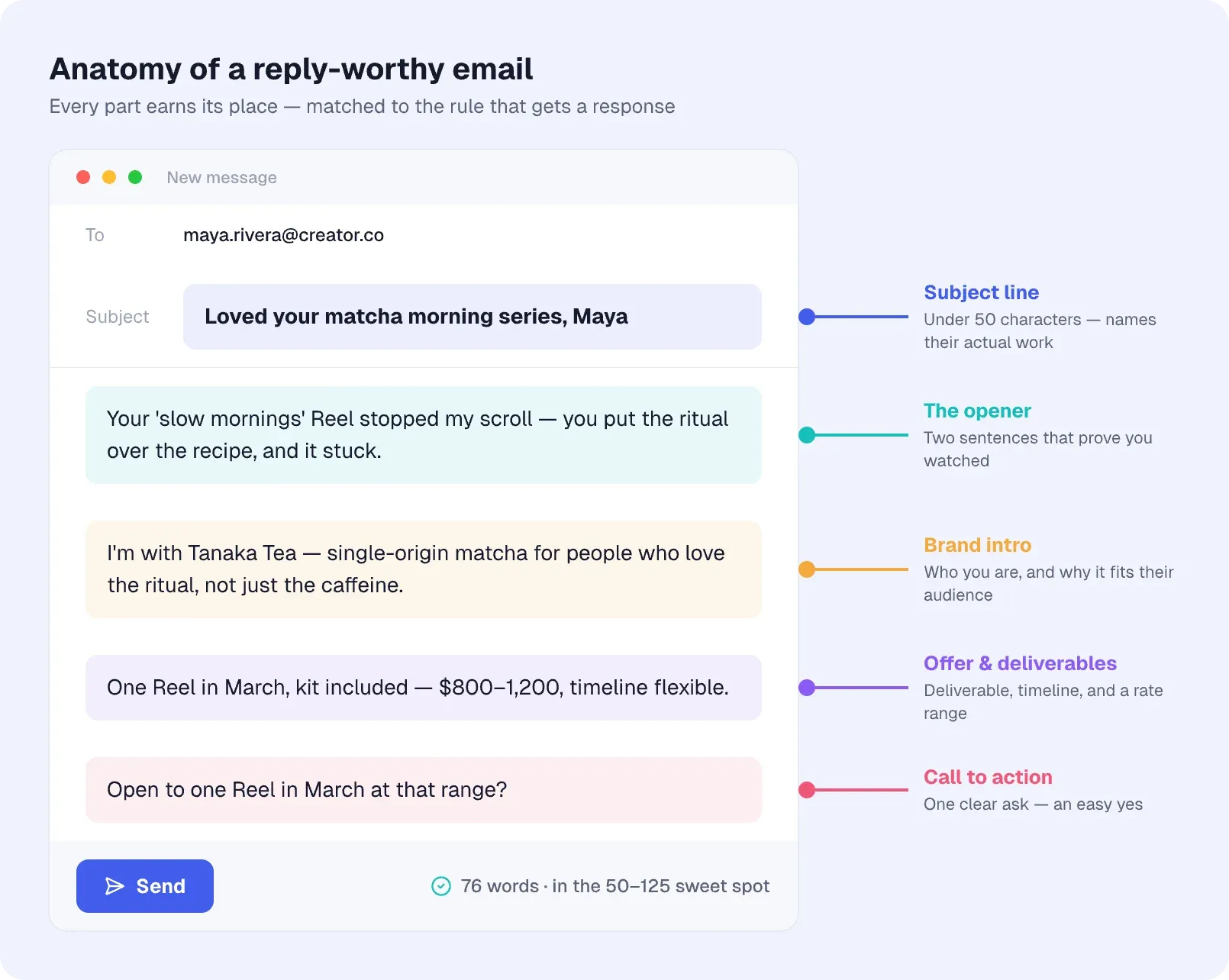
Start with the reader, not your brand. A creator scans the first line to answer one question: does this person actually know my work? If the opener could be pasted to a thousand accounts, they feel it instantly, and they move on. The parts below are the anatomy of a note that earns a reply.
The Subject Line
Keep it under 50 characters and make it specific. "Loved your [topic] breakdown, [First name]" or "[Brand] x [handle]: a quick idea" both signal that you did the homework. Skip vague hooks like "Collaboration opportunity," which read as mass mail and get ignored.
The Opener
Spend your first two sentences proving you watched their content. Name the specific video, post, or series, and say why it landed. This is the single biggest separator between outreach that gets read and outreach that gets deleted, so never outsource it to a merge field.
The Brand Introduction
Now, and only now, introduce your brand in a line or two. Say who you are, what you make, and why it fits their audience. Creators care less about your mission statement than about whether your product suits the people who follow them. Keep it tight and relevant.
The Offer and Deliverables
Be specific about what you want and what you're giving. Spell out the deliverable (one Reel, a three-video series, a story set), a rough timeline, and a rate range or clear compensation. Vague asks stall in the inbox. Concrete ones get a yes or a counter you can work with.
The Call to Action
End with one ask, not three. Make the "yes" easy by proposing a starting point instead of asking a busy creator to invent terms. "Would you be interested in working together sometime?" invites a shrug. "Open to one Reel in March at [rate]?" invites a decision.
Keep It Short
Length matters more than most brands expect. The sweet spot is 50 to 125 words, with roughly 75 words earning the strongest replies and an 8.2% average reply rate in that band, per Overloop's 2026 data. Past 200 words, replies fall off a cliff.
Copy-Paste Influencer Outreach Templates
Use these as scaffolding for first contact, not scripts. Swap the bracketed fields for real and personalized detail, and rewrite at least one line per creator so the note never reads like a form.
Cold Intro (Paid Collaboration)
Hi {{name}},
I enjoyed your recent post: {{url}}. Your approach to the topic and the way you connect with your audience stood out to our team.
I’m reaching out from [Brand]. We’d love to discuss a paid collaboration featuring [product or service], with [deliverable] planned for [timeframe]. Our proposed budget is [rate or range].
Would you be interested in reviewing the campaign brief?
Best,
[Your name]
[Job title], [Brand]
Gifting or Product Seeding
Hi {{name}},
I came across your post here: {{url}}, and I think our [product] would be a great fit for your interests and content.
We’d be happy to send you one to try, with no obligation to post or provide coverage. If you genuinely enjoy it and decide to share your experience, we’d be delighted.
Would you be open to receiving the product? If so, I can send the details and arrange delivery.
Best,
[Your name]
[Job title], [Brand]
Re-Engagement (Past Collaborator)
Hi {{name}},
It was a pleasure working with you on our previous campaign. We especially enjoyed your content here: {{url}}.
We’re now preparing [new campaign], and we’d love to collaborate with you again. This opportunity includes [deliverables], [compensation], and greater flexibility around the creative direction.
Would you be interested in reviewing the new campaign brief?
Best,
[Your name]
[Job title], [Brand]
TikTok DM (Short)
Hi {{name}},
I enjoyed your TikTok post here: {{url}}. I’m reaching out from [Brand] because we’d love to discuss a paid collaboration featuring [product or campaign].
Would you be open to receiving the campaign details and proposed rate?
Best,
[Your name]
[Brand]
Email or DM? Reaching Creators on Each Channel
Channel choice is about fit, not a universal winner. Treat what follows as seasoned judgment rather than a benchmark, because no reliable head-to-head study pits email against DMs for creator reply rates in 2026. The right move depends on where the creator actually pays attention.
First, find the right contact information. Check the bio for a business email, a Linktree, or a "business inquiries" note. If only a DM is open, treat that as a signal the creator prefers the app, and start there rather than hunting for an address they never check.
Here's how the major platforms tend to break down:
| Platform | Best first channel | How to approach |
|---|---|---|
| Email if a business address is listed, otherwise DM | Formal partnerships suit email. Reference a specific post and keep the pitch skimmable. | |
| TikTok | DM first, email follows | Creators live in-app and rarely check a separate inbox. Engage first, then keep it short. |
| YouTube | Email (business address on the About page) | Expect longer lead times. Pitch integrations with clear deliverables and dates. |
| X (Twitter) | Open DMs, otherwise email | Fast and casual. Good for quick-turn or trend-based collaborations. |
| DM or InMail | Best for B2B creators and thought leaders. Lead with relevance, not a hard pitch. | |
| Twitch | Email or Discord | Many streamers route deals through a listed email or a business Discord. |
The rule of thumb across all of them: pitch where the creator already engages, then formalize the deal somewhere you can track it.
When to Send Your Outreach and Your Follow-Ups
Now the first timing question: when should your message actually land? The pattern is consistent across outreach data. Mid-week beats the edges of the week, and mornings beat late afternoons. Tuesday through Thursday tends to outperform Monday and Friday by around 15%, per The Digital Bloom's reply-rate benchmarks.
| Send window (recipient local time) | Reply tendency |
|---|---|
| Tuesday to Thursday, 10 to 11 a.m. | Strongest |
| Tuesday to Thursday, 2 to 4 p.m. | Solid second window |
| Monday and Friday | Roughly 15% weaker |
| Weekends | Usually lowest for business outreach |
One detail decides whether that advice helps or hurts: use the recipient's local time, not yours. A 10 a.m. send from New York lands at 7 a.m. in Los Angeles and mid-afternoon in London.
When you reach out to creators across time zones, schedule to their morning, not yours. A quick lookup with a time zone converter turns their city into a concrete send time, so you skip the mental math on every creator.
Treat every "best time" as a starting hypothesis. In practice, the brands that win keep A/B testing send windows against their own list, because a beauty creator's rhythm differs from a B2B tech reviewer's. The band above is where to begin, not where to stop.
How Many Follow-Ups, and How Far Apart
Most replies do not come from the first email. Across modern outreach datasets, follow-ups drive roughly 40 to 60% of all responses, with Belkins putting the share near the top of that range. Plan for at least half your replies to arrive after message one, and you'll stop giving up too early.
A simple, effective rhythm is the 3-7-7 cadence, which captures around 93% of the replies you'll ever get by day 10. The early touches matter most, and each one should add something new rather than repeat the last note.
| Touch | Day | Purpose |
|---|---|---|
| Initial email | Day 0 | First outreach with your offer |
| Follow-up 1 | Day 3 | Gentle bump, add one piece of value |
| Follow-up 2 | Day 10 | New angle or a bit of social proof |
| Follow-up 3 | Day 17 | Final note and a graceful exit |
Then know when to stop. After two or three follow-ups, returns flatten and the risk of an annoyed "unsubscribe" or spam complaint rises, which, remember, now threatens your whole domain. Persistence works right up until it starts costing you deliverability.
Follow-Up Email Templates
These map to the cadence above. Keep each one shorter than your first email, lead with something new, and never guilt-trip a creator for going quiet. Silence usually means "busy," not "no."
Follow-Up 1 (Day 3): Gentle Bump
Hi {{name}},
I wanted to follow up in case my previous email was overlooked. We enjoyed your content here: {{url}}, and we’d still love to explore a paid collaboration between you and [Brand].
The proposed campaign would involve [deliverable] during [timeframe], with a budget of [rate or range]. Would you be interested in reviewing the brief?
Best,
[Your name]
[Job title], [Brand]
Follow-Up 2 (Day 10): New Angle
Hi {{name}},
I had another look at your post here: {{url}}, and I think a [content format or creative concept] featuring [product] could work especially well for your audience.
We can provide [product, creative support, or another benefit] and offer [rate or range] for [deliverable]. If the idea sounds relevant, I’d be happy to send the complete brief.
Would you be open to taking a look?
Best,
[Your name]
[Job title], [Brand]
Follow-Up 3 (Day 17): Closing
Hi {{name}},
I know schedules get busy, so I wanted to send one final note regarding the [Brand] collaboration I proposed after seeing your content: {{url}}.
I’ll close the loop for now, but please feel free to reply if you’d like to discuss the opportunity later. We’d be glad to reconnect when the timing is right.
Thank you for your time.
Best,
[Your name]
[Job title], [Brand]
From "Yes" to Go-Live: Timing the Content Itself
Here's the second timing question, and it's a different beast. Once a creator signs on, the decision shifts from when you email them to when they publish. Inbox timing gets you the partnership. Posting timing decides how far that partnership reaches.
When the content is ready to publish, you have two ways to set the go-live time. Both work, so pick the one that fits the campaign.
- Agree on a fixed local time. Lock a specific posting slot for maximum reach, or to line up with a launch, sale, or other campaign goal. Confirm the creator's time zone first and check their local time, then arrange content release accordingly so nobody misreads the schedule.
- Let the influencer decide. Hand the call to the creator. They know their fan base and when their audience actually shows up, and that instinct often beats any external chart.
Scaling Outreach Without Losing the Personal Touch
Here's the tension every growing program hits. Everything above works beautifully for 10 creators. Try to run a genuine four-touch cadence, in each recipient's local time, personalized per creator, across 300 of them, and the manual version breaks. Something gets dropped, and it's usually the personalization that made outreach work in the first place.
This is where the right platform earns its place. Tools like Scrumball's outreach automation keep the cadence running without flattening the message.
You can build customizable templates with variable insertion, set an automated follow-up schedule per creator, and lean on AI response suggestions that read an incoming reply's tone and draft a fitting answer. Reply and open tracking sit in one view, so nobody slips through.
The goal is not to remove the human. It is to spend your human effort where it counts, on the opener and the offer, while the system handles timing, spacing, and the tedious parts of contacting many creators at once. Personal at scale beats generic at scale every time.
What Good Looks Like: Reply and Response Benchmarks
Benchmarks vary wildly, and the reason is definitions. "Reply rate," "response rate," and "conversion" get used interchangeably, and a warm, well-targeted creator list behaves nothing like a cold, scraped one. So read any single number with suspicion.
With that caveat in mind, here's a working frame for reading your own numbers. Warmer, better-matched lists sit at the higher end.
| Reply rate | What it signals |
|---|---|
| Under 1% | Cold, net-new, or poorly matched list |
| 3 to 5% | Around average |
| 5 to 10% | Good. Your personalization is landing |
| 10 to 15% | Strong. Tight targeting and a sharp offer |
| 15 to 25% | Excellent, and typical only of warm, well-matched lists |
Those bands draw on The Digital Bloom's benchmark data, where average cold reply rates sit in the low single digits, and top-quartile campaigns reach the mid-teens and up. Strict net-new cold outreach can fall under 1%, which is why "average" is such a slippery word.
The practical takeaway: don't chase someone else's number, track your own trend. Measure open, reply, and booked-collaboration rates per campaign, change one variable at a time, and compare against your last send.
That baseline tells you more than any industry average ever will. If you're still choosing tools to run this, our roundup of top influencer outreach tools and platforms in 2026 is a useful next step.
Where to Start This Week
Pick 10 creators, not 100. Write each opener by hand, propose a concrete offer, and send Tuesday through Thursday morning in the creator's time zone. Follow up twice, a few days apart. Once someone says yes, shift your attention to when they publish, and let timing carry the reach.

Personalize creator messages, automate follow-ups, and keep every promising conversation moving forward with Scrumball today.
Personalize creator messages, automate follow-ups, and keep every promising conversation moving forward with Scrumball today.
FAQs About Influencer Outreaching
What is influencer outreach, and what role does it play in influencer marketing?
Influencer outreach is the process of identifying and contacting relevant creators to propose a brand collaboration. It plays a central role in influencer marketing by connecting creator discovery with negotiation, briefing, and campaign execution.
Effective outreach helps brands secure suitable partners, align on deliverables and compensation, and turn campaign plans into published content.
What is the best way to reach out to influencers: email or DM?
It’s a good idea to follow the contact method the creator lists for business inquiries. Use email for formal paid partnerships involving rates, deliverables, and timelines. Choose a DM when no business email is available, or the creator handles collaborations in-app. Whichever channel you use, reference a specific post, keep the pitch brief, and make one clear offer.
What is the best time to email an influencer?
Send Tuesday through Thursday, mid-morning or early afternoon, in the creator's local time zone rather than yours. That window tends to beat Monday and Friday by roughly 15%. Treat it as a starting point, then A/B test against your own list, since a fashion creator and a tech reviewer keep very different inbox habits.
How many follow-ups should you send before giving up?
Two to three follow-ups are the sweet spot. A day 0, day 3, day 10, day 17 rhythm captures most replies you'll ever get by day 10. Since follow-ups drive 40 to 60% of all responses, sending at least one is essential. Past three, returns flatten, and spam-complaint risk starts threatening your deliverability, so stop.
What is a good reply rate for influencer outreach?
It depends on how cold your list is, but a useful frame is this: above 5% is good, above 10% is strong, and 15% or higher signals tight targeting and sharp messaging. Averages often sit around 3 to 5%. Rather than chase a benchmark, track your own reply rate over time and improve one variable per campaign.