
As influencer marketing continues to mature, relying on assumptions is no longer enough. The latest influencer marketing statistics in 2026 reveal how brands are investing, how consumers respond, and where AI is reshaping the industry. This guide breaks down the most important statistics on influencer marketing to help you make smarter marketing decisions.
Influencer Marketing Statistics At A Glance
Here are five headline statistics that capture the current state of influencer marketing in 2026.
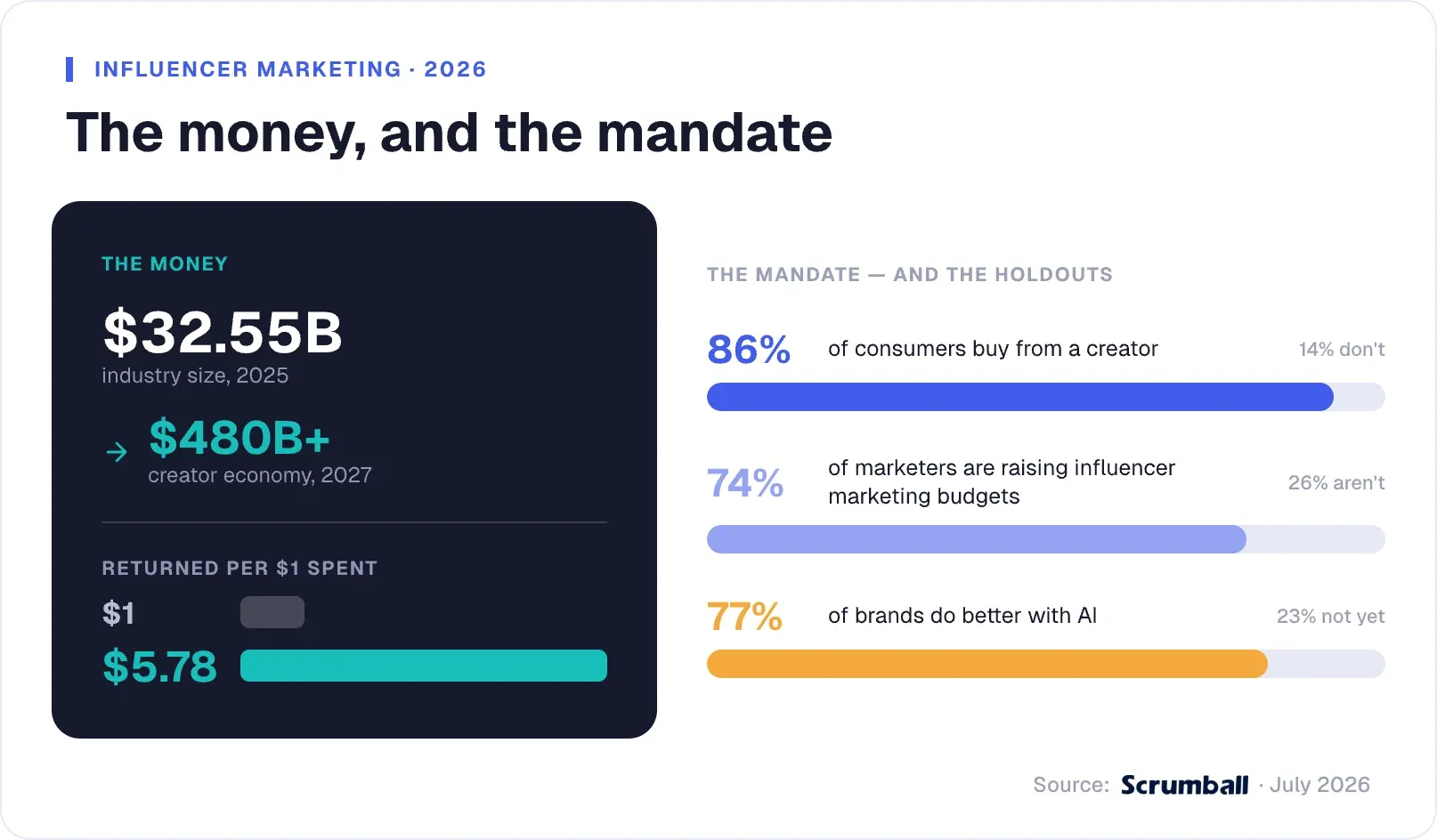
- The global influencer marketing industry reached $32.55 billion in 2025, and the creator economy is projected to exceed $480 billion by 2027.
- 74% of marketers plan to increase their influencer marketing budgets in 2026.
- Influencer marketing generates an average ROI of $5.78 for every $1 spent.
- 86% of consumers make at least one influencer-driven purchase each year.
- 77% of brands report stronger campaign performance with AI-assisted influencer marketing.
45 Influencer Marketing Statistics by Category
The following influencer marketing statistics in 2026 highlight the trends shaping today's creator economy, from market growth and platform performance to AI adoption and consumer behavior.
Reviewing these statistics on influencer marketing helps brands benchmark performance, identify emerging opportunities, and better understand the real benefits of influencer marketing when planning future campaigns.
Influencer Marketing Industry Growth, Investment & ROI Statistics
These influencer marketing statistics in 2026 focus on market expansion, budget allocation, campaign effectiveness, and return on investment. Together, they reveal why influencer marketing continues to attract larger budgets and become a core component of modern marketing strategies.
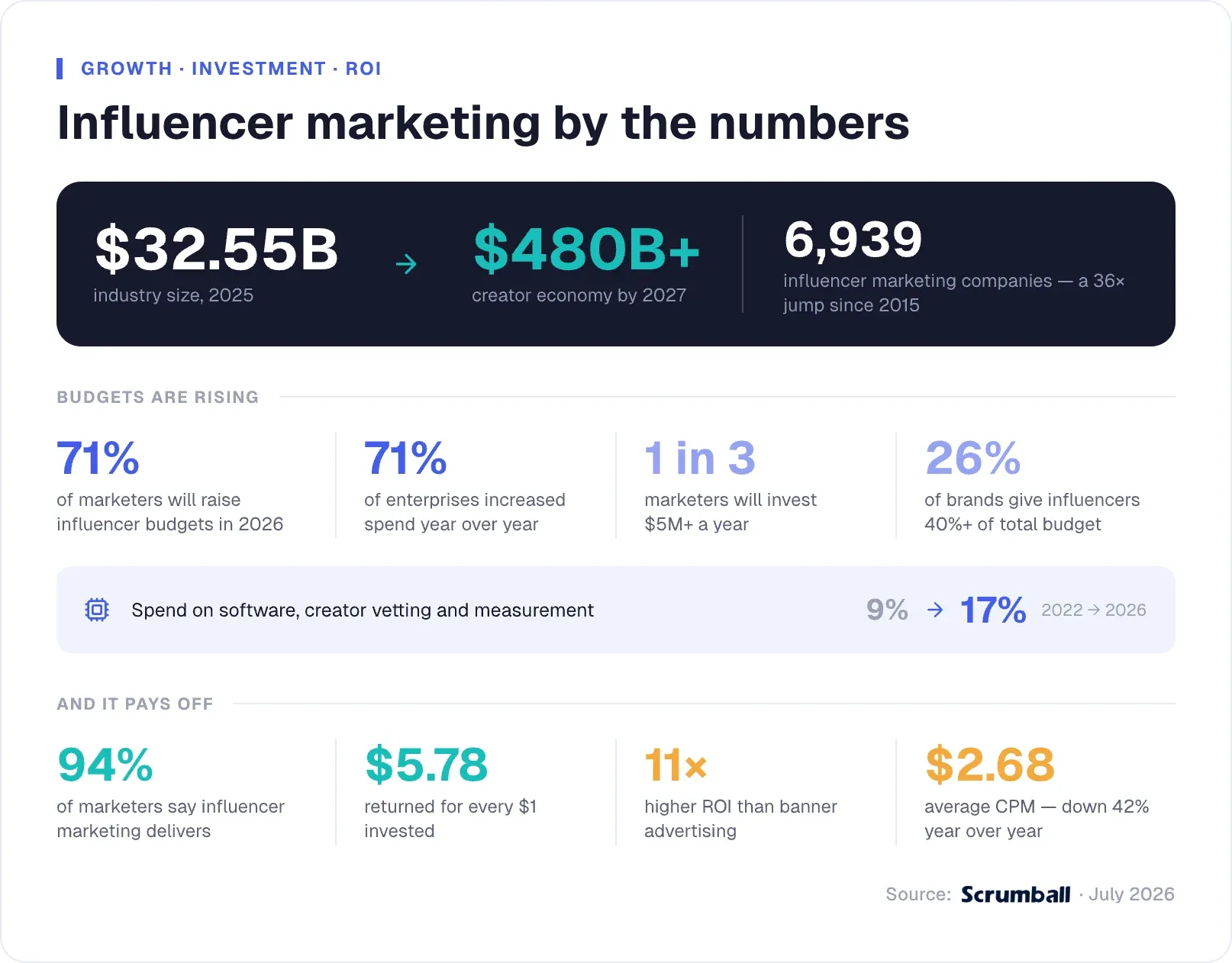
- The global influencer marketing industry reached $32.55 billion in 2025, according to Later via PR Newswire, while Goldman Sachs Research projects the broader creator economy will exceed $480 billion by 2027, highlighting the continued expansion of creator-led marketing and the growing opportunities for brands to engage highly active digital audiences.
- According to CreatorIQ's 2026 State of Creator Marketing report, 71% of marketers plan to increase their influencer marketing budgets in 2026, indicating that influencer marketing is becoming a competitive growth channel. As budgets rise, brands will need stronger creator relationships, better measurement systems, and more strategic partner selection to maximize returns.
- Linqia's influencer marketing research found that around one-third of marketers expect to invest more than $5 million annually in influencer marketing, reflecting how creator collaborations have evolved from experimental campaigns into strategic, enterprise-level marketing initiatives with long-term business objectives.
- CreatorIQ also reports that 71% of enterprise organizations increased influencer marketing investment year over year, indicating that large brands continue to see measurable business value from creator partnerships while reinforcing the importance of developing scalable influencer marketing programs.
- Influencer marketing is now widely recognized as an effective strategy, with 94% of marketers saying it delivers results, according to Marketing Week. This suggests that the industry's focus has shifted away from proving effectiveness toward optimizing creator selection, campaign execution, and performance measurement.
- Influencer marketing delivers an average return of $5.78 for every $1 invested, according to Influee, making it one of the highest-performing digital marketing channels and encouraging brands to view creator partnerships as a revenue-generating investment rather than simply an awareness tactic.
- Social Native reports that over a 12-month measurement period, influencer marketing generates 11 times higher ROI than traditional banner advertising, highlighting the long-term commercial impact of trusted creator recommendations compared with conventional display advertising.
- Influencer marketing CPM has become increasingly cost-efficient, with Aspire reporting that the average CPM fell 42% year over year to $2.68. The decline shows that brands can achieve broader reach at lower media costs while improving overall campaign efficiency and maximizing marketing budgets.
- Sprout Social found that 26% of brands allocate more than 40% of their total marketing budgets to influencer marketing, illustrating that creator partnerships have become a central marketing channel rather than a supplementary tactic for many organizations.
- According to Bizkol, brands now dedicate an average of 17% of their influencer marketing budgets to software, creator vetting, and performance measurement, up from 9% in 2022, reflecting the growing importance of technology and analytics for managing campaigns at scale.
- Influencer Marketing Hub's Benchmark Report 2025 reports that there were 6,939 influencer marketing companies worldwide in 2025, representing a 36-fold increase since 2015, which demonstrates the rapid maturation of the industry and provides brands with a wider range of specialized platforms and service providers.
Influencer Marketing Platform Statistics
These social media influencer marketing statistics compare performance across platforms such as Instagram, TikTok, and YouTube. Understanding where audiences engage, discover products, and make purchases helps brands allocate budgets more effectively and choose the right platform for every campaign objective.
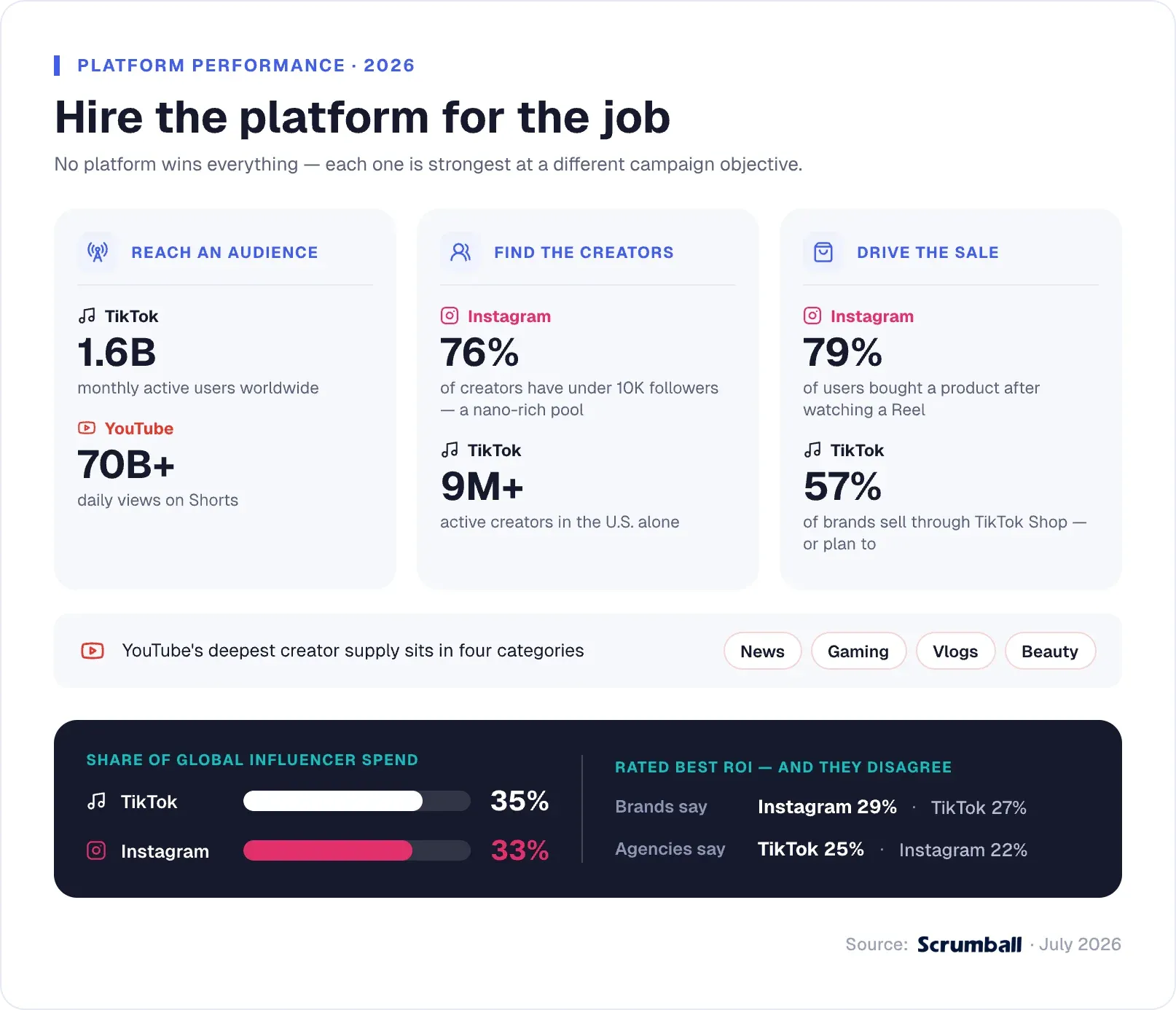
- Platform ROI perceptions vary depending on the stakeholder, with brands ranking Instagram (29%) as the highest-performing influencer marketing platform, followed by TikTok (27%), while agencies place TikTok (25%) ahead of Instagram (22%), according to Marketing Charts. The findings reinforce that brands should evaluate platforms based on specific campaign goals rather than popularity alone.
- According to HypeAuditor's latest Instagram influencer marketing statistics, 76% of Instagram creators have fewer than 10K followers, demonstrating that the platform is dominated by nano influencers and reinforcing the value of prioritizing niche relevance and authentic engagement over audience size.
- Instagram Reels has become a powerful driver of influencer commerce, with 79% of users reporting that they have purchased a product after watching a Reel, according to Pulse Advertising. This highlights the exceptional conversion potential of short-form video and its growing importance for brands pursuing commerce-focused influencer campaigns.
- According to Influencer Fee, TikTok now accounts for approximately 35% of global influencer marketing spending, surpassing Instagram for the first time at 33%, reflecting the platform's growing influence on product discovery and encouraging brands to expand creator investments where younger audiences spend the most time.
- HypeAuditor reports that with over 1.6 billion monthly active users worldwide, and Scrumball's database shows that over 9M+ active TikTok influencers in the U.S. alone, TikTok offers brands access to an enormous creator ecosystem, making it easier to identify niche influencers with highly engaged audiences.
- According to Aspire, 57% of brands already sell through TikTok Shop or plan to do so, illustrating how social commerce and influencer marketing are increasingly converging and creating new opportunities for creators to drive measurable sales beyond traditional brand awareness. Meanwhile, brands increasingly need creators who can influence purchase decisions, not just generate engagement or visibility.
- TechTimes reports that YouTube Shorts now generates more than 70 billion daily views worldwide, confirming that short-form video has become central to YouTube's ecosystem and giving brands another high-reach channel for scalable influencer campaigns beyond TikTok.
- According to AWISEE, News, Gaming, Vlogs, and Beauty & Makeup remain the most-watched categories on YouTube, helping brands quickly identify where creator supply is strongest while reminding marketers to balance category size with audience engagement when selecting campaign partners.
Influencer & Creator Statistics
These influencer marketing statistics in 2026 examine the evolving creator economy, including creator demographics, influencer tiers, engagement trends, and collaboration preferences. Together, they reveal how the creator ecosystem is becoming larger, more specialized, and increasingly performance-driven.
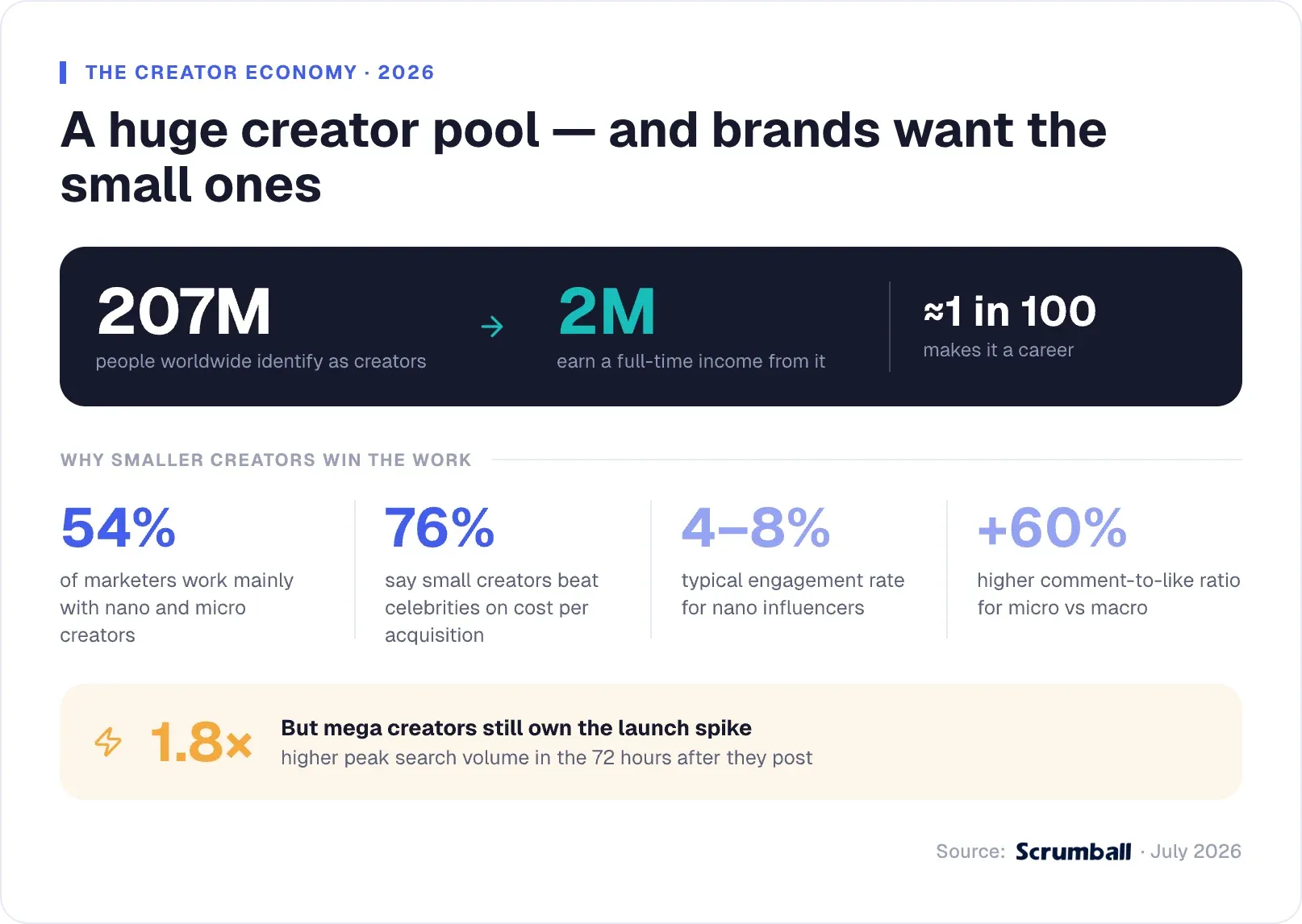
- According to Outfame, more than 207 million people worldwide identify as creators, while around 2 million earn a full-time income from content creation, illustrating the rapid expansion of the creator economy and giving brands access to an increasingly diverse pool of potential marketing partners.
- Smaller influencers continue to dominate brand partnerships, with 54% of marketers primarily collaborating with nano and micro creators and 76% believing they outperform celebrities on CPA, according to Influencer Marketing Hub's Benchmark Report. These findings show that smaller creators often deliver stronger cost efficiency through higher trust and closer audience relationships.
- According to Influee, nano influencers typically achieve engagement rates of 4%–8%, while micro influencers generate 60% higher comment-to-like ratios than macro creators, demonstrating that smaller audiences often produce deeper conversations and making engagement quality a more valuable metric than follower count alone.
- Bizkol reports that although brands increasingly favor smaller creators, mega influencers still generate 1.8× higher peak search volume within 72 hours after posting, making them particularly valuable for product launches and awareness campaigns that require immediate, large-scale visibility.
Influencer Campaign & Collaboration Statistics
These statistics on influencer marketing explore how brands structure creator partnerships and which collaboration approaches consistently deliver stronger business outcomes. They also highlight why long-term relationships are becoming a defining characteristic of successful influencer marketing strategies.
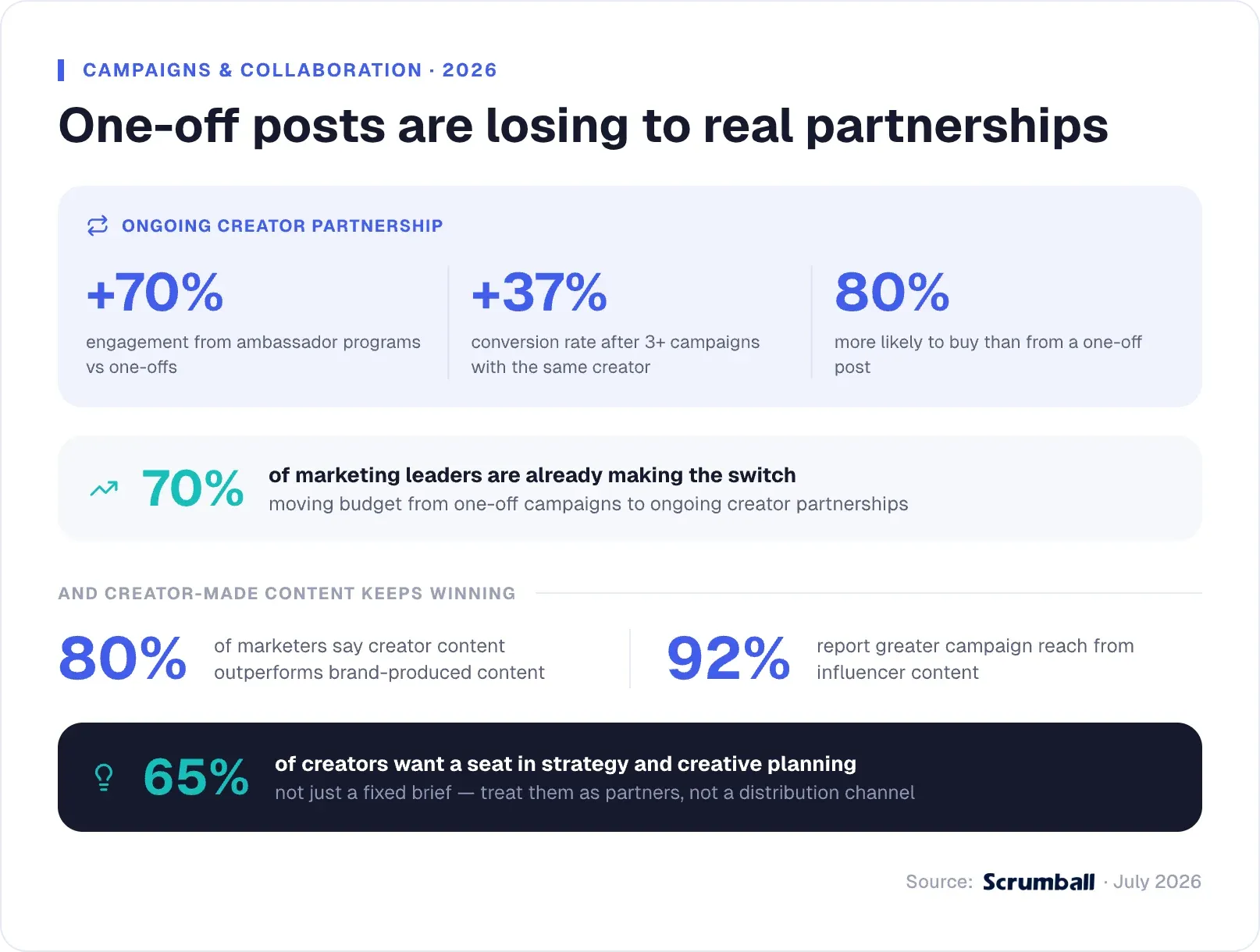
- Creator content is increasingly outperforming traditional brand-produced content, with 80% of marketers saying it delivers better results and 92% reporting greater campaign reach from influencer content, according to Statista. This indicates brands should shift from controlling every message toward empowering creators to produce audience-native content, improving performance across multiple marketing channels.
- Statista also reports that 70% of marketing leaders are shifting from one-off campaigns toward ongoing creator partnerships, recognizing that long-term collaborations build stronger audience trust, improve creative consistency, and generate more sustainable results over time.
- According to GRIN, brand ambassador programs consistently generate 70% higher engagement than one-off sponsored campaigns, showing that repeated exposure strengthens consumer familiarity and enables brands to maximize the long-term value of creator relationships.
- Statista reports that brands running three or more campaigns with the same creator improve conversion rates by 37%, while consumers are 80% more likely to purchase from long-term influencer partnerships than from one-off sponsored posts. It demonstrates that trust compounds through consistent creator-brand relationships, highlighting why always-on creator programs often outperform short-term promotional campaigns.
- Research from YouScan found that 65% of creators want to participate in campaign strategy and creative planning instead of simply following a fixed brief, suggesting that brands achieve stronger campaign performance when they treat influencers as creative partners rather than just distribution channels.
AI in Influencer Marketing Statistics
These influencer marketing statistics in 2026 demonstrate how AI is reshaping every stage of influencer marketing, from creator discovery and campaign planning to measurement and optimization. They also highlight where human creativity remains irreplaceable despite rapid technological adoption.
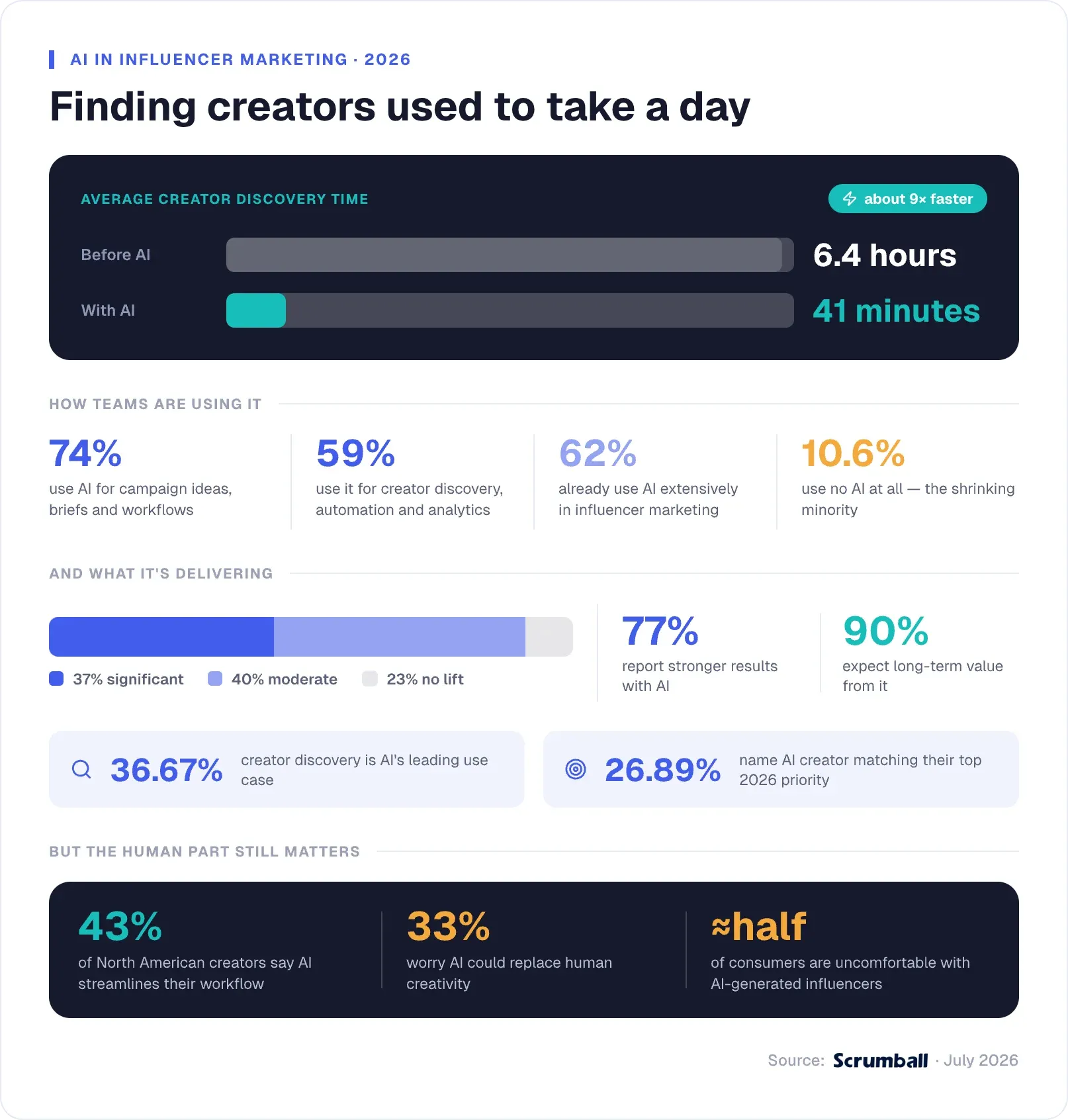
- AI has become a practical productivity tool for marketing teams, with 74% of marketers using it to generate campaign ideas, write briefs, and streamline workflows, according to Statista. This helps teams reduce manual work, accelerate execution, and improve campaign efficiency without sacrificing strategic oversight.
- Statista also found that 59% of marketers rely on AI to scale creator discovery, workflow automation, and campaign analytics, showing that brands increasingly use AI to handle time-intensive operational tasks so teams can focus more on strategy, relationship building, and performance optimization.
- 77% of brands report stronger results from AI-assisted influencer marketing, including 37% that describe the improvement as significant, according to Statista, confirming that AI delivers measurable business value when paired with thoughtful creator selection and effective campaign management.
- AI is no longer viewed as an emerging technology. Statista reports that 62% of brands already use AI extensively in influencer marketing, while 90% believe it will create long-term value, indicating that AI has become a core capability for brands seeking faster, smarter, and more scalable marketing operations.
- Influencer Marketing Hub's Benchmark Report reveals that AI creator matching is the top influencer marketing priority for 26.89% of marketers in 2026; creator discovery is AI's leading use case at 36.67%; only 10.56% of marketers report using no AI; and AI has reduced average creator discovery time from 6.4 hours to just 41 minutes, illustrating how AI is fundamentally transforming influencer marketing by improving both decision quality and operational efficiency.
- AI is helping many creators work more efficiently, with 43% of North American creators saying it streamlines their workflow, according to eMarketer. At the same time, 33% worry AI could eventually replace human creativity, Technology Checker reports, suggesting that while creators welcome AI as a productivity tool, authentic storytelling remains essential.
- Despite the rapid adoption of AI, nearly half of consumers feel uncomfortable with AI-generated influencers, according to Baringa. The findings suggest that trust still depends largely on genuine human creators who can build authentic emotional connections with their audiences.
Consumer Behavior & Trust Statistics
These statistics on influencer marketing reveal how consumers discover products, build trust, and make purchasing decisions through creator content. Understanding these behaviors helps brands develop campaigns that resonate more authentically and generate stronger commercial results.
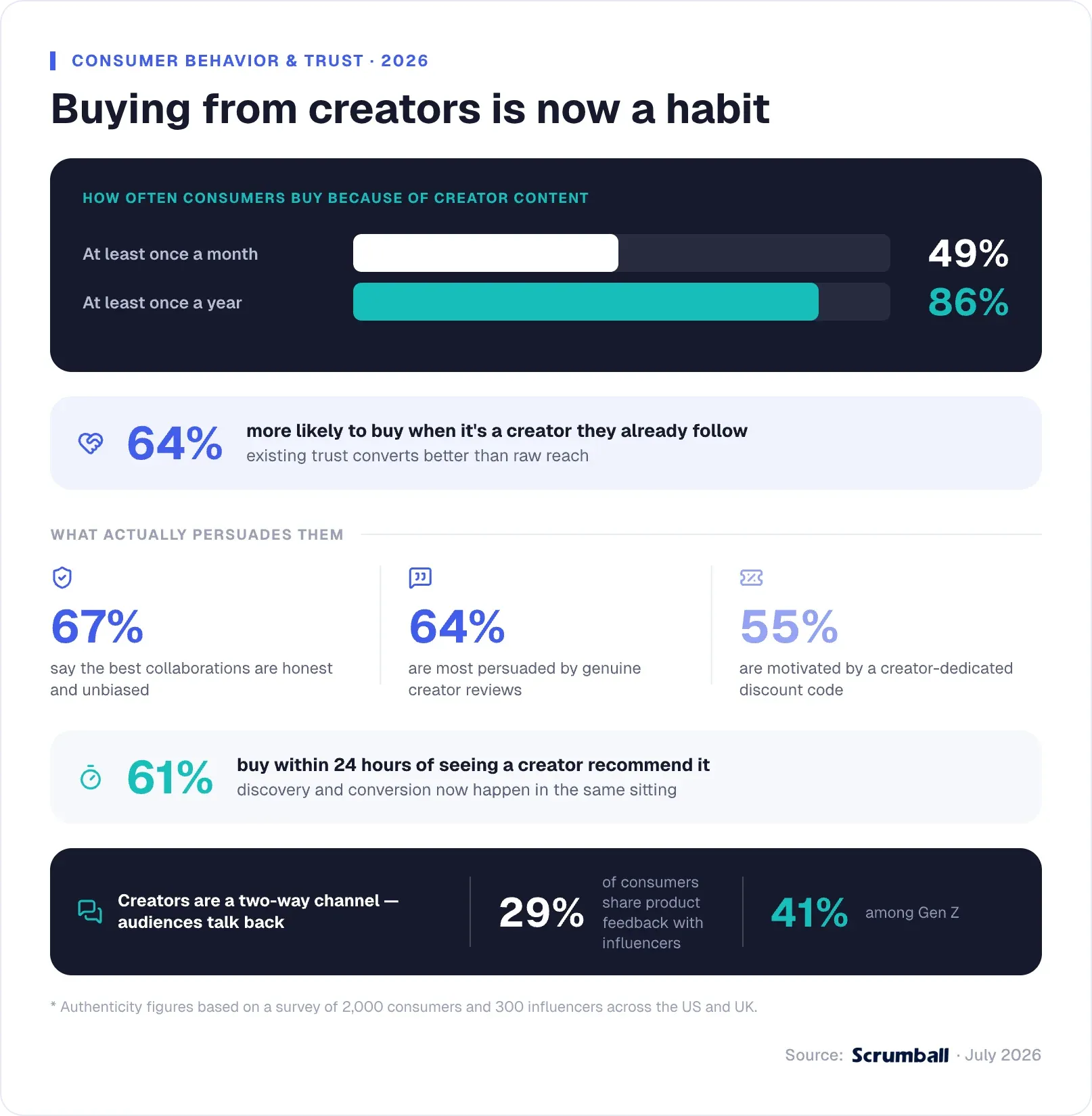
- Sprout Social reports that 86% of consumers make at least one influencer-driven purchase each year, while 49% buy at least once a month because of creator content, demonstrating that influencer marketing consistently shapes purchasing behavior rather than driving only occasional viral sales.
- Consumers are 64% more likely to purchase when a brand partners with an influencer they already follow and trust, according to Statista, reinforcing that creator credibility and audience relationships are often more influential than reach alone when driving conversions.
- A survey cited by Net Influencer found that among 2,000 consumers and 300 influencers across the US and UK, 67% believe the most effective brand and influencer collaborations are honest and unbiased, emphasizing that authenticity remains one of the strongest drivers of engagement and encouraging brands to prioritize transparent partnerships over overly scripted promotions.
- According to Sprout Social's State of Influencer Marketing Report, summarized by Lindsey Gamble, 64% of consumers are most persuaded by genuine creator reviews, while 55% are motivated by discount codes, showing that the highest-converting campaigns combine authentic product experiences with clear purchasing incentives rather than relying on promotional messaging alone.
- Bizkol reports that 61% of consumers purchase a product within 24 hours after seeing a creator recommend it, highlighting how influencer content can rapidly shorten the path from product discovery to conversion when audiences already trust the creator's recommendations.
- 29% of consumers share product feedback directly with influencers, rising to 41% among Gen Z, according to Empower. This demonstrates that creators increasingly function as two-way communication channels, giving brands valuable customer insights beyond traditional surveys and reviews.
Regional Influencer Marketing Statistics
These influencer marketing statistics compare spending trends, consumer behavior, and market adoption across major regions, helping brands understand geographic differences and build more effective, locally relevant influencer marketing strategies.
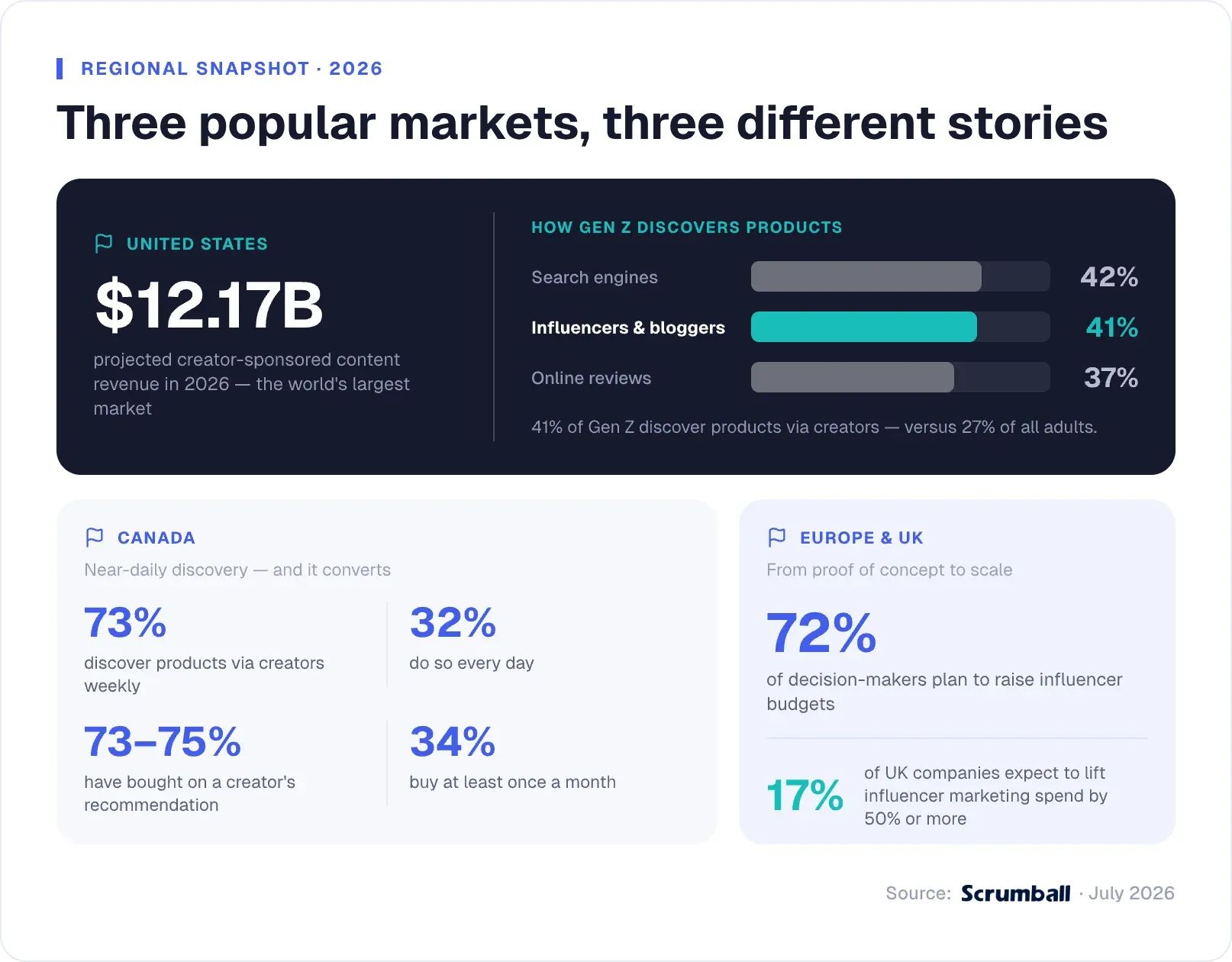
- The United States remains the world's largest influencer marketing market. Statista projects that creator-sponsored content revenue will reach $12.17 billion in 2026, confirming the country's leadership in global investment while continuing to shape many of the industry's emerging trends.
- Data reported by Net Influencer shows that 41% of Gen Z among U.S. consumers discover new products through influencers or bloggers compared with just 27% of all adults, while influencer recommendations nearly match search engines (42%) and outperform online reviews (37%) for Gen Z, illustrating how younger audiences increasingly rely on creators as a primary product discovery channel.
- According to Ad Standards, approximately 73% of consumers in Canada discover products through influencers every week; 32% do so daily; around 73–75% have purchased because of creator recommendations; and 34% buy at least monthly, making these insights particularly valuable for brands evaluating Canadian brand influencer marketing statistics in 2026 and planning localized creator campaigns.
- Confidence in influencer marketing continues to grow across Europe. NetInfluencer reports that 72% of decision-makers plan to increase influencer marketing budgets, while 17% of UK companies expect to raise spending by 50% or more, indicating that creator marketing is moving from experimentation toward long-term strategic investment.
How to Turn Influencer Marketing Statistics into Action
Reading influencer marketing statistics is only valuable if they lead to better decisions. Brands need a clear influencer marketing strategy to translate data into repeatable campaigns.
The most successful brands use industry data to shape campaign planning, creator selection, execution, and measurement—turning market insights into repeatable, scalable growth. The following four practical ways show how to translate these insights into a more effective influencer marketing strategy.
- Set Clear Campaign Goals: Before choosing creators, define measurable objectives that align with business outcomes, whether that means increasing brand awareness, driving engagement, generating conversions, or boosting sales. Clear KPIs make it easier to evaluate campaign success and determine which benefits of influencer marketing statistics are most relevant to your strategy.
- Choose the Right Creators with Data: Replace manual creator searches with data-driven influencer discovery. Platforms like Scrumball help brands search across 180M+ creator profiles spanning Instagram, TikTok, and YouTube, then evaluate each creator through 90+ dimensions, like audience, engagement, authenticity, and brand fit, supported by AI-assisted analytics for faster, more confident influencer selection.
- Use AI to Improve Campaign Efficiency: AI is transforming every stage of influencer marketing. Platforms such as Scrumball use AI agents to accelerate creator research, generate campaign recommendations, streamline outreach, and simplify campaign management, allowing marketing teams to execute larger, more sophisticated campaigns without increasing manual work.
- Track the Metrics That Matter: Measure more than impressions and engagement. Track creator performance, conversions, audience quality, ROI, earned media value, and campaign efficiency. With Scrumball's performance tracking, brands can analyze completed campaigns, identify top-performing creators and strategies, and apply those insights to optimize future influencer campaigns.
Ultimately, influencer marketing statistics show that success depends on combining reliable data with intelligent execution. Turning those insights into measurable business outcomes, however, requires the right technology. AI-powered influencer marketing platforms like Scrumball enable brands to discover better creators, automate repetitive workflows, measure performance accurately, and continuously improve campaign results at scale.
Conclusion
The latest influencer marketing statistics confirm that influencer marketing remains one of the fastest-growing and highest-performing digital channels. Brands that combine reliable data, AI-powered tools, and continuous performance optimization will be better positioned to build stronger creator partnerships and deliver more effective, scalable campaigns throughout 2026 and beyond.
FAQs
Is influencer marketing still effective in 2026?
Yes. The latest influencer marketing statistics in 2026 show that influencer marketing remains one of the highest-performing digital marketing channels, generating an average ROI of $5.78 for every $1 spent. Additionally, 94% of marketers consider it effective, while 86% of consumers make influencer-driven purchases annually, proving its commercial impact.
What platforms matter most for influencer marketing in 2026?
Instagram, TikTok, and YouTube remain the leading platforms in social media influencer marketing statistics, with each serving different campaign goals. Instagram delivers strong conversion performance according to Instagram influencer marketing statistics, TikTok excels at discovery and commerce, while YouTube supports deeper product education.
Beyond the big three, LinkedIn has become the default for B2B creator programs, with 55% of B2B marketers already running them according to the LinkedIn-Ipsos 2025 B2B Marketing Benchmark. Pinterest suits high-intent shopping categories like home, beauty, and fashion, while Twitch and podcasts reach gaming communities and executive buyers that broader social platforms rarely capture.
How are marketers in 2026 using AI to do influencer marketing?
Marketers are using AI to improve creator discovery, campaign planning, content ideation, and performance analytics. According to the latest influencer marketing statistics, 59% of marketers already integrate AI into workflows, helping brands scale campaigns while reducing manual research and optimization efforts.
Why does authenticity matter so much for influencer marketing in 2026?
Authenticity remains a key driver of trust and conversions, especially when brands work with micro-influencers who often build stronger audience relationships. 64%of consumers are more likely to purchase when brands partner with influencers they already follow and trust, highlighting the value of genuine creator relationships.
Is influencer marketing worth it for small businesses?
Yes, and a smaller budget often favors smaller creators. Nano and micro influencers deliver 4% to 8% engagement and stronger cost per acquisition than celebrity partnerships, letting a limited budget fund several creators instead of one expensive post. With 76% of Instagram creators holding fewer than 10K followers, there is no shortage of niche partners to test.
Will AI replace human influencers?
Both trends are running at once. AI personas are now established on TikTok and YouTube, and brand adoption of virtual influencers rose from 60% to 73% according to Influencer Marketing Hub, largely because they speed up content production and cost less to run at volume.
The counterweight is trust. Nearly half of consumers feel uncomfortable with AI-generated influencers, and 33% of creators worry about being replaced. Most brands settle in the middle, using AI to accelerate production while keeping human creators for credibility.