
Influencer marketing brand awareness works because people discover brands through people they already watch, trust, and talk about. In 2026, that matters more than ever. Paid feeds are crowded, search is changing, and audiences are quicker to ignore messages that feel like polished corporate interruption.
The channel has also grown up. Mordor Intelligence estimates the influencer marketing market at $40.51 billion in 2026, with creator partnerships now treated as a strategic growth lever instead of an experimental line item.
That shift is not only happening in consumer categories. Sprout Social reports that 67% of B2B brands use influencer marketing to increase brand awareness, while 54% use it to build credibility and trust.
That does not mean every creator post builds awareness. The campaigns that work combine audience fit, creative freedom, fraud checks, clear disclosures, and measurement that goes beyond likes. When those pieces line up, influencer marketing turns borrowed attention into remembered brand equity.
What Is Influencer Marketing and Its Role in Brand Awareness?
Defining the Strategy
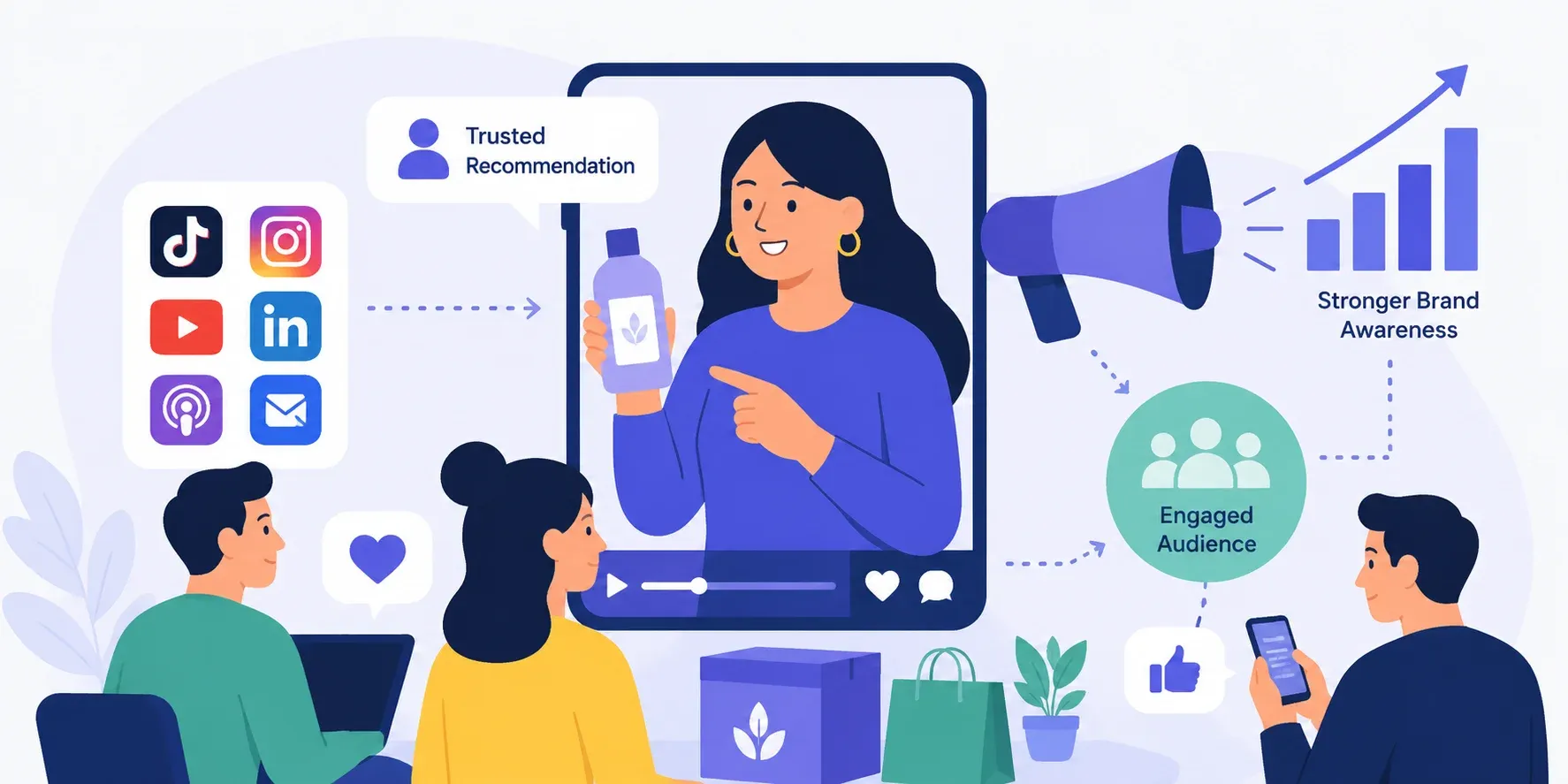
Influencer marketing is the practice of partnering with creators who already have credibility with a defined audience. Unlike old celebrity endorsements, modern creator partnerships usually happen through TikTok, Instagram, YouTube, LinkedIn, podcasts, newsletters, and niche communities.
The job is not just to rent reach. The real value is trust transfer. When a creator explains why a product fits their life, work, routine, or taste, the brand borrows context that a billboard or banner ad cannot create on its own.
Recognition also changes buying behavior. The report cites research showing that 71% of consumers say recognizing a brand before purchase is important, and 46% tend to buy from familiar brands.
Why It Builds Awareness Faster
Brand-owned organic reach is still limited, especially on mature social platforms. A creator gives you access to an audience that has already opted in. That is why a small creator with a specific community can sometimes create more useful awareness than a broad media buy.
Newer trust research is more nuanced than the old "everyone trusts recommendations" line. The 2025 Influencer Trust Index found that 74% of consumers trust influencer advertising at least somewhat, but only 5% trust it completely.
The same study found that 58% of consumers have purchased because of influencer endorsements, and 35% have made four to six purchases based on influencer content. Awareness is doing real work before the sale shows up.
That is the point many teams miss. Influencers do not build awareness because they are famous. They build awareness when their audience believes the recommendation belongs in the creator's world.
The Shift from Traditional Ads
Traditional advertising still has a role, but it often starts cold. Creator content starts inside a relationship. Instead of asking someone to stop what they are doing, it appears in the feed, format, and tone they already chose.
The 2026 Influencer Marketing Benchmark Report shows video as the dominant content format. That matters for awareness because video lets creators demonstrate, explain, compare, and repeat a brand message without making it feel like a static ad.
Context matters too. IAS research on contextual advertising found matched placements drove 23% higher detail memory and 27% higher global memory. Creator content works on the same principle: the message fits the moment.
Key Benefits of Influencer Marketing Brand Awareness Campaigns
1. Access to Niche Audiences
Targeting "women aged 25-34" is a start, not a strategy. Partnering with a vegan meal prep creator, a B2B RevOps analyst, or a skincare chemist gives your brand cultural context, audience language, and a sharper reason to be noticed.
This is why micro and nano creators keep showing up in serious plans. Later's 2025 report found that 73% of brands prefer micro and mid-tier creators because of their engagement-to-cost ratio.
Engagement benchmarks make the tradeoff concrete. InfluenceFlow benchmarks nano creators at 8-12% engagement and micro creators at 4-8%, while macro and mega accounts often sit lower. Smaller audiences can still create stronger memory.
2. Content at Scale
Creators are mini production studios with distribution built in. A campaign with 10 creators can generate 10 distinct pieces of content: product demos, reactions, tutorials, short videos, testimonials, comparison posts, or behind-the-scenes clips.
That content does not have to disappear after the post goes live. With the right usage rights, brands can repurpose creator assets for paid social, email, landing pages, sales enablement, retail media, and website proof points.
3. Stronger Social, Search, and AI Discovery Signals
When multiple credible creators talk about a brand at the same time, it creates a visible pattern. People search the brand name, share posts, mention it in comments, and ask friends whether they have seen it.
Those signals now matter beyond traditional social algorithms. As buyers use AI assistants and answer engines to compare products, third-party mentions, reviews, creator content, and consistent brand language can help a brand become easier to recognize and summarize.
How Influencer Marketing Works: A Step-by-Step Guide
Step 1: Define Your Goal and Audience
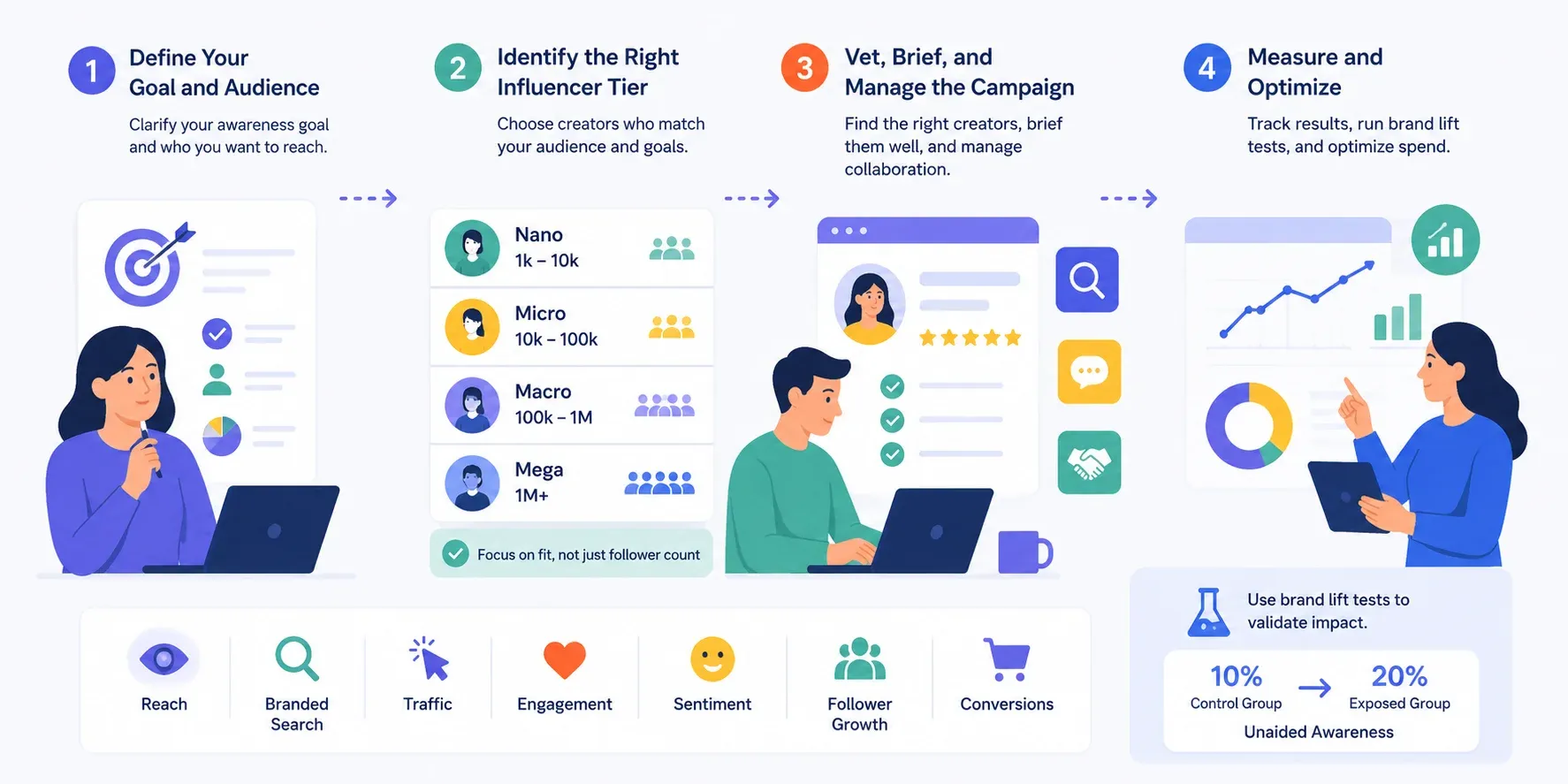
Before you send a DM, define what awareness means. Is the goal reach, recall, branded search lift, traffic quality, share of voice, audience sentiment, or category association? The answer decides which creators, platforms, and metrics belong in the campaign.
A CPM goal needs different partners than a trust-building campaign. An engagement goal needs different creative than a launch campaign. We have found that messy influencer results usually start with vague goals, not bad creators.
Step 2: Identify the Right Influencer Tier
- Nano (1k-10k): High community trust, lower cost, and strong fit for local or niche awareness.
- Micro (10k-100k): Often the sweet spot for reach, credibility, and manageable campaign volume.
- Macro (100k-1M): Useful for broad visibility, launches, and category-level awareness.
- Mega (1M+): Massive reach, higher cost, and best used when the creator has clear brand relevance.
The tier is less important than the match. A creator with 20,000 deeply relevant followers can outperform a celebrity if the audience sees the recommendation as useful rather than rented.
Step 3: Vet, Brief, and Manage the Campaign
Discovery should include audience quality, content history, comment authenticity, past sponsorships, platform mix, and brand safety. Tools like Scrumball help teams move this work from spreadsheet guessing into a managed workflow across discovery, outreach, campaign tracking, collaboration, and payments.
Do not over-script the creator. Give them the product truth, key claims, disclosure rules, and guardrails. Then let them translate the message into their voice. Content that looks like an ad usually performs like an ad.
Step 4: Measure and Optimize
Track UTM links, discount codes, landing page visits, branded search, direct traffic, follower growth, sentiment, comment quality, and assisted conversions. Awareness should not be judged only by last-click sales.
For higher-confidence proof, use brand lift tests. A Swayable and Influential meta-study analyzed more than 70,000 consumer responses and found influencer content nearly doubled brand favorability compared with traditional ads.
Use simple math to explain the lift. If unaided recall is 10% in a control group and 20% in the exposed group, the campaign doubled unaided awareness within that tested audience.
CreatorIQ's State of Creator Marketing 2025-2026 found that organizations are increasing creator investment while putting more pressure on ROI. The best response is not softer reporting. It is a better campaign design and cleaner measurement.
UTM discipline helps with that pressure. The report notes that brands using UTM tracking can improve influencer campaign efficiency by 40%, because teams can shift spend toward creators that drive traffic, search, and conversions.
Overcoming Common Challenges in Influencer Marketing
Identifying Fake Followers
Fraud is still real. The 2026 Influencer Marketing Benchmark Report says fake or bot followers account for 56.5% of reported fraud and quality issues. That makes audience authenticity a budget issue, not just a nice-to-have check.
Look for sudden follower spikes, repetitive comments, weak audience location fit, suspicious engagement patterns, and content that attracts views but not conversation. Scrumball or HypeAuditor-style checks help teams avoid paying for reach that never had a chance to build real brand awareness.
Ensuring Brand Safety
Your reputation travels with the creator. Review past posts, comment tone, controversial topics, disclosure habits, and previous brand partnerships before signing. Clear contracts with morality clauses protect the brand if a partner's behavior creates risk during the campaign.
Compliance matters too. The FTC endorsement and influencer guidance tell brands and creators to disclose material relationships clearly. A 2026 YouTube affiliate disclosure study also found that compliance remains a concern in creator commerce.
The trust numbers are blunt. The Influencer Trust Index found that 71% of consumers value transparency about brand relationships, 79% value authentic reviews, 80% distrust creators who seem inauthentic, and 70% feel deceived by undisclosed partnerships.
Transparency does not weaken awareness. It protects it. If an audience feels misled, the brand may gain impressions while losing trust, which is the opposite of what a brand awareness campaign is supposed to do.
The Future of Brand Awareness
AI and Data-Driven Selection
The days of manual searching are fading. AI tools can analyze creator content, audience overlap, sentiment, fraud signals, pricing, and past performance faster than a human team can review profiles one by one.
Still, AI should support judgment, not replace it. CreatorIQ reported that 95% of brands used AI in marketing over the past year, while Later found 92% of brands already use or are open to AI for influencer workflows.
That does not make relationship work optional. Marketers were least eager for AI to replace relationship management. That is exactly right. Awareness is built by human trust, not just database matching.
Long-Term Ambassadorships
One-off posts are losing ground because audiences are good at recognizing quick paid placements. Brands are shifting toward 6-12 month ambassador relationships where creators can repeat the message, answer questions, test angles, and build familiarity over time.
Always-on programs support that shift. Sprout Social reports that 58% of B2B marketing teams use an always-on influencer approach, and 99% of teams using that model rate their programs as effective.
That repetition creates memory structures. A buyer may not click the first post, but after seeing the same trusted creator mention the brand several times, they are more likely to remember it, search it, or recognize it later in a buying moment.
Conclusion
Influencer marketing is powerful for brand awareness because it combines reach with borrowed credibility. The 2026 winners will not be the brands that buy the biggest follower counts. They will be the teams that choose better partners, measure smarter signals, and build creator relationships worth remembering.
FAQ
Does influencer marketing increase brand awareness?
Yes. Brand lift research analyzed more than 70,000 consumer responses and found influencer content nearly doubled brand favorability compared with traditional ads. It works best when campaigns track reach, recall, branded search, sentiment, and traffic quality.
Are micro influencers better for brand awareness?
Micro influencers can be better for focused awareness because their audiences are often specific and engaged. Later found 73% of brands prefer micro and mid-tier creators. Nano creators are often benchmarked at 8-12% engagement, while micro creators often sit around 4-8%.
How should brands measure influencer marketing for awareness?
Brands should measure awareness with reach, impressions, engagement quality, branded search lift, direct traffic, social mentions, audience sentiment, referral traffic, and brand lift surveys. UTMs and promo codes connect creator exposure to behavior, and disciplined UTM tracking can improve campaign efficiency by 40%.
What makes an influencer partnership trustworthy?
A trustworthy influencer partnership has audience fit, clear disclosures, honest product experience, natural creative, and consistent brand alignment. In the Influencer Trust Index, 71% of consumers valued transparency, 79% valued authentic reviews, and 70% felt deceived when a brand relationship was not disclosed.
How can Scrumball help with influencer brand awareness campaigns?
Scrumball helps teams manage the full creator campaign lifecycle: discovery, outreach, influencer vetting, campaign management, performance tracking, collaboration, and payments. For awareness campaigns, that means marketers can compare creators, monitor execution, reduce manual work, and connect creator activity to the signals that show whether the brand is being remembered.